For more than three decades, enterprise software has evolved through distinct eras. The first era digitized business processes through ERP, CRM, and workflow systems. The second connected organizations through cloud platforms, analytics, and mobile applications. Today, a third era is emerging, one that will fundamentally redefine how enterprises operate, make decisions, and create value.
This new era is not being driven by applications alone.
It is being shaped by the convergence of applications, AI agents, and knowledge graphs.
Organizations worldwide are investing billions in artificial intelligence, automation, and digital transformation. Yet many are discovering an uncomfortable reality: AI is only as effective as the context it can access. Despite advances in large language models and generative AI, enterprise intelligence remains fragmented across disconnected applications, databases, documents, emails, workflows, and business systems.
As enterprises move from automation toward intelligent operations, a critical question emerges:
What architecture will power the next generation of enterprise software?
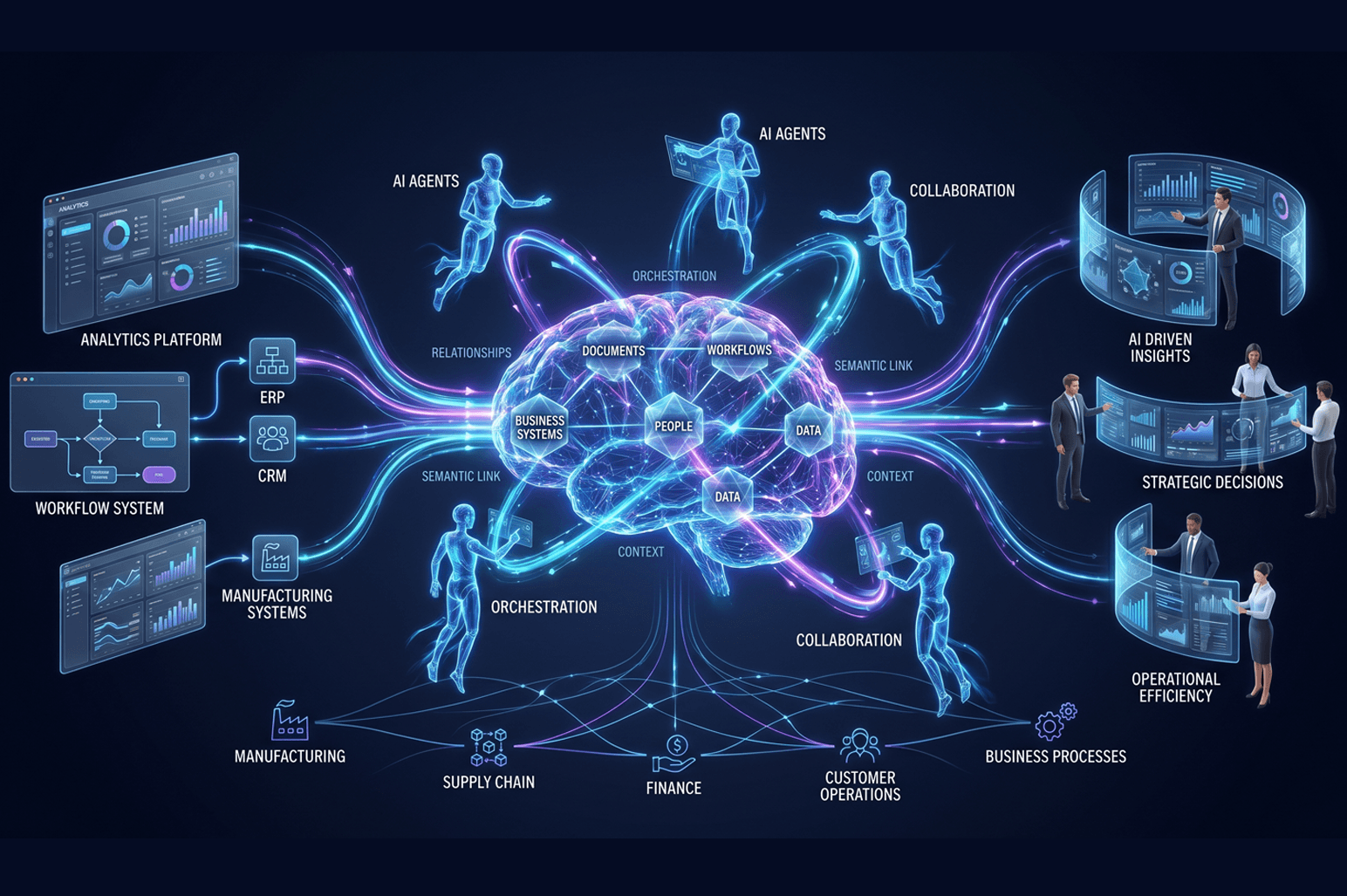
Increasingly, the answer lies in combining applications that execute business processes, AI agents that perform work autonomously, and knowledge graphs that provide the contextual intelligence required for meaningful decision-making.
Why Traditional Enterprise Software is Reaching Its Limits
Most enterprise software was designed for a world where humans interacted directly with applications.
Employees logged into systems, searched for information, completed transactions, approved workflows, and manually connected insights across departments. While these systems improved operational efficiency, they created a new challenge: information fragmentation.
Today, a typical enterprise may operate hundreds of applications across functions such as finance, manufacturing, procurement, customer service, quality management, and supply chain operations. Each application stores valuable information, but that information is often isolated from the broader business context.
As a result:
- Data exists in silos.
- Decision making becomes slower.
- Business knowledge is difficult to discover.
- AI systems struggle to access relevant context.
- Operational intelligence remains fragmented.
The challenge is no longer a lack of software. The challenge is a lack of connected intelligence.
The Rise of AI Agents in Enterprise Operations
The rapid advancement of generative AI has introduced a new operational model: AI agents.
Unlike traditional software systems that execute predefined instructions, AI agents can understand goals, analyze information, make recommendations, initiate workflows, and collaborate with users to complete tasks.
AI agents represent a significant evolution in enterprise software.
Instead of navigating multiple applications manually, users can increasingly interact with intelligent agents capable of orchestrating work across systems.
Imagine a manufacturing supervisor asking:
“Why did production efficiency drop last week?”
Rather than searching through dashboards, spreadsheets, maintenance systems, and quality reports, an AI agent could analyze operational data across multiple sources, identify contributing factors, generate insights, and recommend corrective actions.
Similarly, a quality manager could ask:
“Show all deviations related to this production line and identify recurring root causes.”
The AI agent would retrieve relevant information, connect operational relationships, and present contextual insights instantly.
However, for AI agents to deliver this level of intelligence, they require something most enterprises currently lack.
They require context.
The Enterprise AI Problem: Intelligence Without Context
Many organizations assume that implementing AI automatically creates intelligent operations.
In reality, AI systems often fail because they cannot understand the relationships between people, processes, systems, assets, documents, and business events.
Enterprise data is typically spread across:
- ERP systems
- CRM platforms
- Manufacturing systems
- Document repositories
- Workflow applications
- IoT devices
- Databases
- Email and collaboration tools
While AI models can access information from individual systems, they often struggle to understand how everything connects.
This creates a fundamental limitation.
AI can process information.
But without context, it cannot generate enterprise intelligence.
This is where knowledge graphs become transformational.
What is a Knowledge Graph?
A knowledge graph is a structured representation of relationships between people, systems, processes, assets, documents, events, and business entities.
Unlike traditional databases that store information in isolated tables, knowledge graphs capture how information is connected across an organization.
For example, a knowledge graph can understand that:
- A machine belongs to a production line.
- A production line supports a specific product.
- A product is associated with customer complaints.
- Those complaints are linked to quality deviations.
- Quality deviations relate to maintenance events.
- Maintenance events involve specific technicians and suppliers.
Instead of viewing information as isolated records, a knowledge graph creates a connected representation of enterprise knowledge.
This connected context enables AI systems to understand relationships, dependencies, and business meaning.
In simple terms:
Applications store information.
AI agents perform work.
Knowledge graphs provide understanding.
Together, they create intelligent enterprise systems.
Why Knowledge Graphs Will Become the Foundation of Enterprise AI
As organizations scale AI adoption, they face a growing challenge.
Every new AI agent requires access to business context.
Without a unified understanding of enterprise relationships, organizations risk creating dozens or hundreds of disconnected AI assistants that generate inconsistent outputs.
Knowledge graphs solve this problem by creating a shared intelligence layer across the enterprise.
This enables AI agents to:
- Access contextual business knowledge.
- Understand relationships between systems.
- Reason across multiple data sources.
- Deliver more accurate recommendations.
- Continuously learn from organizational interactions.
The result is a shift from isolated AI tools toward connected enterprise intelligence.
This is why leading analysts increasingly view knowledge graphs as a critical component of future enterprise AI architectures.
The Future Enterprise Architecture: Applications + Agents + Knowledge Graphs
The next generation of enterprise software will operate differently from traditional systems.
Rather than relying exclusively on applications and dashboards, organizations will adopt architectures where applications, AI agents, and knowledge graphs work together continuously.
Applications will continue to manage transactions, workflows, and business operations.
AI agents will automate tasks, assist users, orchestrate processes, and generate insights.
Knowledge graphs will provide the contextual intelligence that connects everything together.
This creates a new operating model where employees interact with enterprise intelligence rather than individual software systems.
Instead of asking:
“Which application contains this information?”
Users will ask:
“What do I need to know?”
The system will determine where information exists, how it relates to business objectives, and what actions should be taken.
This shift represents one of the most significant transformations in enterprise technology since the introduction of ERP systems.
Introducing GraphX: The Enterprise Intelligence Platform
As organizations move toward AI-driven operations, they need more than applications and AI tools. They need a platform that connects enterprise knowledge, workflows, data, and intelligence.
This is precisely why GraphX was created.
GraphX is an enterprise knowledge graph and agent orchestration platform designed to enable connected intelligence across the organization.
Rather than functioning as another application layer, GraphX serves as an enterprise intelligence layer that connects people, systems, processes, documents, workflows, and AI agents through a shared knowledge graph.
This allows organizations to move beyond isolated AI implementations and build intelligent systems that continuously learn, adapt, and evolve.
With GraphX, enterprises can:
- Connect structured and unstructured enterprise data.
- Create a unified knowledge graph across business functions.
- Enable AI agents to reason across enterprise context.
- Orchestrate multiple AI agents through shared intelligence.
- Build continuously evolving enterprise knowledge assets.
- Accelerate decision-making through contextual insights.
Unlike traditional AI solutions that rely solely on prompts and retrieval, GraphX creates a persistent organizational memory that compounds in value over time.
Every interaction, workflow, relationship, and business insight contributes to a growing intelligence ecosystem.
This is what transforms AI from a tool into an enterprise capability.
How Contineo and GraphX Work Together
While GraphX provides the intelligence layer, Contineo provides the operational execution layer.
Contineo enables organizations to rapidly build applications, automate workflows, integrate enterprise systems, and digitize business operations through its low-code, no-code platform.
Together, Contineo and GraphX create a complete enterprise intelligence architecture.
Contineo manages workflows, applications, and operational processes.
GraphX connects enterprise knowledge, contextual relationships, and AI agents.
This combination enables organizations to move beyond traditional digital transformation and build adaptive, intelligent enterprises capable of continuous learning and autonomous decision support.
The Future Belongs to Connected Intelligence
The future of enterprise software will not be defined by larger applications or more dashboards.
It will be defined by how effectively organizations connect intelligence across their operations.
Applications alone cannot solve the complexity of modern enterprises.
AI agents alone cannot generate reliable outcomes without context.
Knowledge graphs alone cannot drive business execution.
The future belongs to organizations that combine all three.
Applications will execute.
AI agents will act.
Knowledge graphs will understand.
Together, they will create a new generation of enterprise systems that are more intelligent, adaptive, and capable than anything built before.
For enterprise leaders, the question is no longer whether AI will transform software.
The real question is whether their organization is building the architecture required to harness it.
And increasingly, that architecture will be built on applications, AI agents, and knowledge graphs.