Enterprise operations are entering a structural shift that is larger than digital transformation itself.
For the last decade, organizations invested heavily in automation, workflow digitization, cloud platforms, and analytics. Yet despite billions spent on enterprise technology, most operational environments remain fragmented. Teams still move between disconnected systems. Data remains siloed across departments. Decision-making is delayed by operational complexity. And employees spend a significant portion of their time managing systems instead of driving outcomes.
Artificial intelligence is now forcing enterprises to rethink this model entirely.
The next generation of operational transformation will not be defined by standalone AI tools or isolated automation initiatives. It will be defined by how effectively organizations enable collaboration between human intelligence and AI-driven operational systems.
This shift is already underway. According to McKinsey, organizations that successfully integrate AI into operational workflows can improve productivity by 20 to 40 percent depending on the function and maturity of implementation. At the same time, Gartner estimates that by 2028, over one third of enterprise software interactions will involve agentic AI systems capable of independently executing tasks and orchestrating workflows.
The implication is significant.
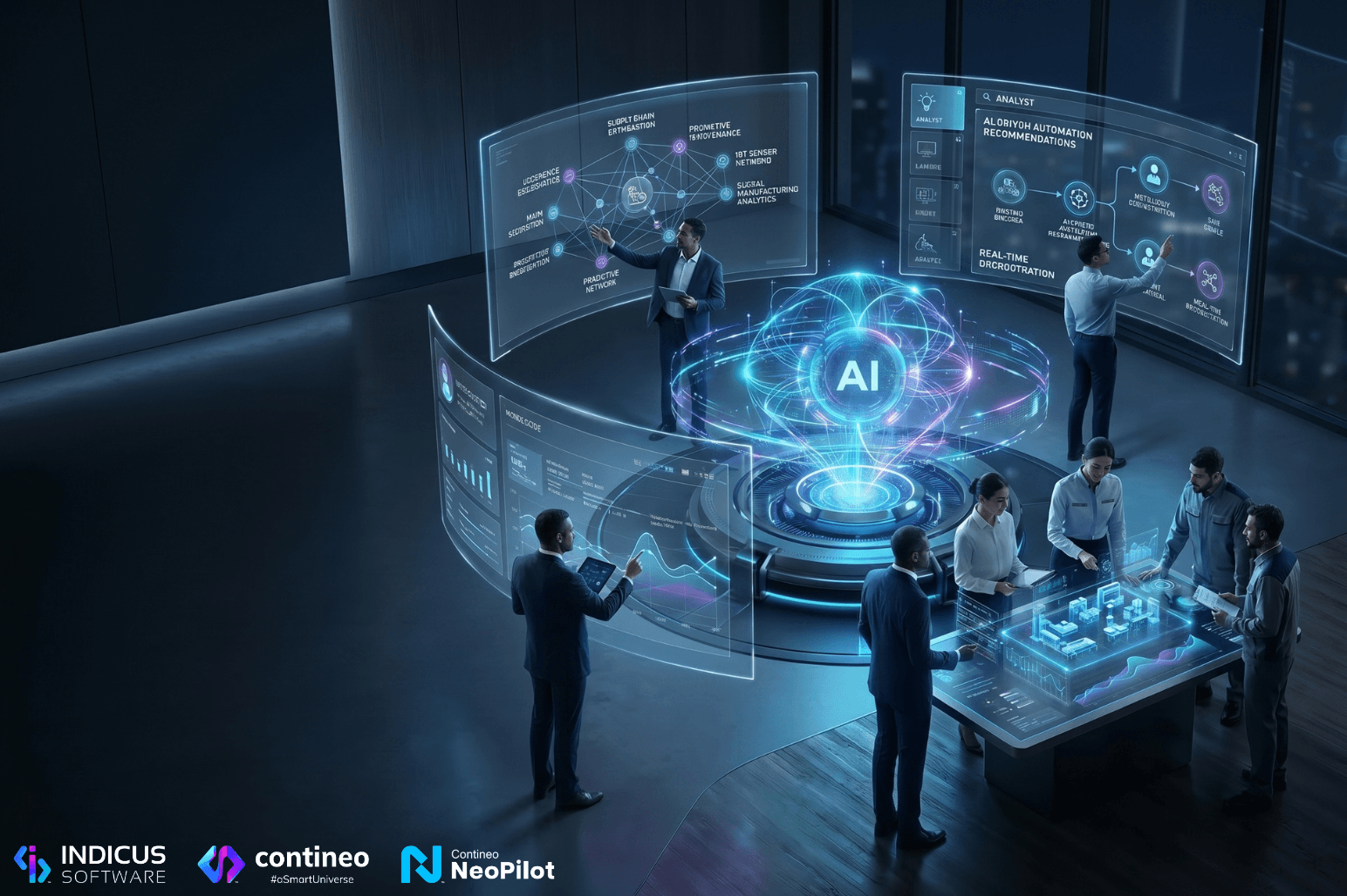
The future enterprise will not operate through static software systems alone. It will operate through intelligent ecosystems where humans, AI agents, workflows, and operational data continuously collaborate in real time.
The Enterprise Problem is No Longer Automation
Most enterprises today do not suffer from lack of software.
They suffer from operational fragmentation.
Manufacturing teams use separate systems for production analytics, maintenance workflows, and quality management. Customer operations rely on disconnected CRM, service, and communication platforms. Enterprise approvals move across emails, spreadsheets, ERP systems, and workflow tools that rarely communicate effectively with one another.
As operational complexity increases, employees become the integration layer between systems.
This creates three structural problems:
1. Decision Latency
Critical operational decisions are delayed because insights are spread across multiple systems and departments.
2. Human Cognitive Overload
Employees spend excessive time collecting, validating, and interpreting operational information rather than acting on it.
3. Limited Operational Agility
Traditional enterprise systems are designed around predefined workflows, making them slow to adapt to changing business conditions.
This is precisely where human + AI collaboration changes the enterprise operating model.
Human + AI Collaboration is Not About Replacing Employees
One of the biggest misconceptions surrounding enterprise AI is that automation replaces human expertise.
In reality, the highest performing enterprises are adopting a collaborative intelligence model where AI augments human capabilities rather than replacing them.
AI systems excel at processing massive datasets, detecting patterns, automating repetitive actions, and monitoring operations continuously. Humans excel at contextual judgment, strategic reasoning, ethical oversight, and managing ambiguity.
The future enterprise combines both.
In practical terms, this means AI handles operational scale while humans focus on strategic direction and exception management.
For example:
- AI agents can monitor production systems 24/7 and identify equipment anomalies before failures occur.
- Human supervisors evaluate operational priorities and determine business impact.
- AI systems can orchestrate workflows automatically across departments.
- Leadership teams make strategic decisions based on AI generated insights and recommendations.
This model significantly reduces operational friction while improving speed, consistency, and decision quality.
The Shift From Automation to Autonomous Operations
Traditional automation systems are rule-based.
They execute predefined workflows but cannot dynamically adapt to operational context.
Modern AI-driven enterprise systems are fundamentally different.
Agentic AI systems can analyze operational data, initiate workflows, interact with users conversationally, and coordinate actions across systems with minimal human intervention.
This is the transition from automation to autonomous operations.
In autonomous operational environments:
- AI agents proactively identify operational risks
- Systems dynamically adjust workflows based on real time conditions
- AI continuously monitors enterprise KPIs and operational anomalies
- Employees collaborate with AI systems through conversational interfaces
- Operational intelligence becomes embedded directly into workflows
This evolution is particularly important in industries where operational complexity is high and response speed directly impacts revenue, efficiency, or compliance.
Why Most Enterprise AI Initiatives Fail
Despite growing investment in AI, many enterprise initiatives struggle to deliver measurable operational impact.
The reason is rarely the AI model itself.
The failure point is architecture.
Most organizations attempt to layer AI onto fragmented enterprise environments that were never designed for intelligent orchestration. AI systems become isolated assistants instead of operational participants.
Without unified workflows, integrated data architecture, and connected operational systems, AI cannot drive enterprise level transformation.
This is why enterprises are increasingly moving toward integrated operational platforms that combine:
- Workflow orchestration
- Low code application development
- Data integration
- AI agent orchestration
- IoT connectivity
- Enterprise governance
The market is shifting from standalone AI tools toward intelligent operational ecosystems.
Real World Enterprise Collaboration Models
Human AI collaboration is already creating measurable operational outcomes across industries.
In manufacturing environments, AI-powered predictive maintenance systems continuously analyze vibration patterns, temperature fluctuations, and machine performance data to detect anomalies before failures occur. Human engineering teams then prioritize interventions based on production schedules and operational impact. This reduces unplanned downtime while improving asset utilization.
In life sciences and regulated industries, AI-assisted workflow systems streamline documentation, compliance reviews, and quality management processes while maintaining human oversight for governance and regulatory accountability.
In telematics operations, AI systems analyze driver behavior, route efficiency, and risk indicators in real time. Operational teams use these insights to improve safety performance, optimize fleet operations, and reduce operational costs.
Contineo’s enterprise implementations already support many of these operational scenarios across manufacturing, mobility, life sciences, and intelligent monitoring environments
The key insight is this:
The most valuable AI systems are not isolated assistants. They are operational collaborators embedded directly into enterprise workflows.
Why Enterprise Platforms Must Evolve Beyond Traditional Low Code
Most low-code platforms were originally designed to accelerate application development.
That is no longer enough.
The next generation of enterprise platforms must support intelligent operational orchestration across people, systems, workflows, and AI agents simultaneously.
This is where the industry is rapidly evolving.
Enterprises increasingly require platforms capable of:
- Connecting fragmented operational systems
- Embedding AI into enterprise workflows
- Supporting autonomous decision support
- Enabling real-time operational intelligence
- Allowing business users and AI agents to collaborate directly
This evolution is driving the rise of intelligent operational platforms.
Contineo and GraphX: Building the Infrastructure for Collaborative Intelligence
Contineo was built to solve a problem most enterprise platforms still struggle with: operational fragmentation.
Unlike traditional low-code platforms that focus primarily on front-end application development, Contineo combines workflow orchestration, enterprise data integration, IoT connectivity, low-code development, and AI-driven automation within a unified operational architecture.
This enables enterprises to build operational systems where AI is embedded directly into workflows rather than added as an external layer.
GraphX represents the next evolution of this architecture.
While traditional enterprise platforms organize systems around isolated applications and databases, GraphX introduces an intelligent knowledge-driven operational layer that connects enterprise data, workflows, systems, and AI agents through contextual relationships.
This enables organizations to move from disconnected operational systems toward self-evolving enterprise intelligence environments.
In practical terms, GraphX enables enterprises to:
- Connect fragmented enterprise knowledge without moving all operational data
- Create contextual AI-driven decision systems
- Enable AI agents to reason across workflows and operational dependencies
- Build continuously learning operational ecosystems
This architecture becomes increasingly critical as enterprises scale AI adoption across departments and operational functions.
The competitive difference is significant.
Most low-code and AI platforms still operate as isolated productivity tools.
Contineo and GraphX are designed as enterprise intelligence infrastructure.
The Organizations That Win Will Build Collaborative Intelligence Early
The enterprise AI conversation is no longer about experimentation.
It is becoming an operational necessity.
Organizations that continue treating AI as a standalone assistant or isolated automation layer will struggle to scale operational intelligence effectively. Those that build integrated human + AI collaboration environments will operate with greater agility, visibility, and resilience.
The winners of the next decade will not simply automate faster.
They will build enterprises capable of continuous operational learning.
Human + AI collaboration is not a future possibility. It is rapidly becoming the foundation of intelligent enterprise operations.
The question for enterprise leaders is no longer whether AI will transform operations.
The real question is whether their current operational architecture is ready for it.
Build the Foundation for Intelligent Enterprise Operations
Contineo and GraphX help enterprises move beyond fragmented systems and isolated automation toward connected, AI-driven operational intelligence.
From workflow orchestration and intelligent automation to AI agents and enterprise knowledge systems, organizations can build scalable operational ecosystems designed for the future of collaborative intelligence.
Explore how Contineo and GraphX are enabling the next generation of enterprise operations.