
A Complete Guide for Enterprises
In today’s rapidly evolving digital landscape, businesses are under constant pressure to build applications faster, reduce development costs, and respond quickly to changing market demands. This is where low-code, no-code platforms are transforming the way organizations approach software development.
Low-code/no-code platforms are development environments that enable users to build applications using visual interfaces, drag-and-drop components, and pre-built templates with minimal or no coding. These platforms empower both developers and non-technical users to create applications efficiently, accelerating digital transformation across industries.
Understanding Low-Code/No-Code Platforms
At their core, low-code platforms require minimal coding and are typically used by developers to build complex, scalable applications faster. On the other hand, no code platforms are designed for business users with no programming knowledge, allowing them to create applications using purely visual tools.
Together, low-code/no-code platforms bridge the gap between IT teams and business users, enabling faster collaboration and reducing dependency on traditional development cycles.
Low Code vs No Code: Key Differences
While both approaches aim to simplify application development, they serve different user groups and use cases.
Low-code platforms provide greater flexibility, customization, and integration capabilities, making them ideal for enterprise-grade applications. No code platforms focus on simplicity and speed, making them suitable for smaller applications and quick solutions.
For enterprises, low code development platforms are often the preferred choice due to their ability to scale, integrate with existing systems, and handle complex workflows.
Key Features of Low-Code/No-Code Platforms
Modern low-code, no-code platforms offer a wide range of capabilities that make application development faster and more efficient.
They provide intuitive visual development environments where users can design applications using drag-and-drop interfaces. Built-in workflow automation allows organizations to streamline business processes without writing extensive code. Integration capabilities enable seamless connectivity with enterprise systems such as ERP, CRM, and IoT platforms.
Additionally, these platforms support real-time analytics, role-based access control, and cloud deployment, making them suitable for enterprise-level use cases.
Why Enterprises are Adopting Low-Code/No-Code Platforms
The adoption of low-code/no-code platforms is growing rapidly among enterprises due to the significant business benefits they offer.
Organizations can drastically reduce development time, allowing applications to be built and deployed in days instead of months. This leads to faster innovation and improved time to market. By reducing reliance on traditional coding, businesses can lower development costs and optimize resource utilization.
Low-code platforms also enable business users to participate in application development, improving collaboration between departments. This results in more aligned solutions that directly address business needs.
Top Low-Code/No-Code Platforms in the Market
Several platforms dominate the low-code no-code landscape, each offering unique capabilities for different use cases.
Popular platforms include Microsoft Power Apps, Mendix, OutSystems, and Appian, which are widely adopted for enterprise application development. These platforms provide strong ecosystems, integration capabilities, and scalability.
In addition to these, emerging platforms like Contineo are redefining the space by combining low-code/no-code capabilities with advanced technologies such as AI, IoT, and agent-driven automation. This evolution is enabling organizations to move beyond simple application development toward building intelligent and connected systems.
Why Prefer Contineo for a Low-Code/No-Code Platform
Choosing the right low-code no-code platform is a strategic decision for enterprises aiming to scale digital transformation. While platforms like Mendix, OutSystems, Kissflow, and Microsoft Power Apps offer strong capabilities, Contineo stands out by going beyond traditional application development and enabling a truly integrated, intelligent enterprise ecosystem.
Contineo is not just a low-code/no-code platform. It is a comprehensive enterprise-grade platform that combines application development, workflow automation, data integration, IoT capabilities, and AI-driven orchestration into a single unified environment. This eliminates the need for multiple disconnected tools and enables organizations to build, deploy, and scale applications seamlessly across departments and systems.
One of the key differentiators of Contineo is its powerful model-driven architecture with auto-generation of CRUD operations, workflows, and user interfaces. This allows both developers and business users to rapidly build complex applications with minimal effort, significantly reducing development time while maintaining flexibility and control. Unlike many platforms that require heavy customization for enterprise use cases, Contineo enables dynamic configuration of data models, business logic, and user interfaces through rule-based routing, making it highly adaptable to diverse business requirements.
Another major advantage is Contineo’s deep integration with AI and agent-based automation through GraphX. While most low-code platforms focus only on application development, Contineo enables organizations to build intelligent systems where AI agents can automate workflows, interact with users, and orchestrate business processes. This positions Contineo ahead of competitors by transforming applications into intelligent, decision-capable systems rather than static tools.
Contineo also excels in handling complex, real-world enterprise scenarios. It has been successfully implemented across industries such as manufacturing, life sciences, mobility, and smart cities, supporting use cases like OEE monitoring, predictive analytics, digital logbooks, and telematics platforms. These capabilities demonstrate its ability to handle large-scale, mission-critical applications with high performance and reliability
Compared to Mendix and OutSystems, which may involve higher licensing costs and dependency on specialized development skills, Contineo offers a more flexible and efficient approach with faster implementation, a lower total cost of ownership, and more robust and scalable architecture.
Ultimately, Contineo is designed not just to accelerate application development but to enable end-to-end digital transformation. By combining low-code, no-code development with AI, automation, and data-driven intelligence, it empowers enterprises to build scalable, future-ready systems that evolve with their business needs.
Real-World Use Cases of Low-Code/No-Code Platforms
One of the biggest advantages of low-code/no-code platforms is their ability to deliver practical, real-world solutions across industries.
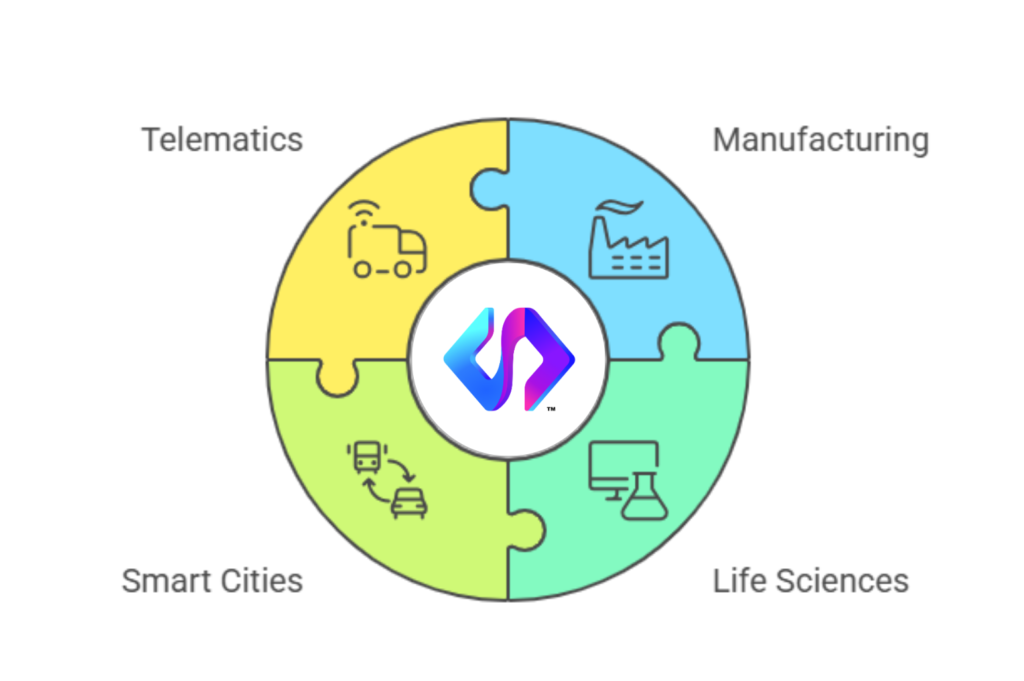
In manufacturing, organizations use these platforms for OEE monitoring, predictive maintenance, and KPI analytics, enabling better operational efficiency. In life sciences, digital logbooks and quality management systems streamline compliance and improve data accuracy. Smart city initiatives leverage low-code platforms for mobility solutions such as car-sharing systems and real-time monitoring.
Telematics platforms powered by low-code development enable advanced analytics, driver behavior tracking, and real-time alerts, helping organizations optimize fleet management and safety
These use cases highlight how low-code/no-code platforms are not just development tools but critical enablers of enterprise digital transformation.
The Future of Low-Code/No-Code Platforms
The future of low-code/no-code platforms is being shaped by the integration of artificial intelligence and automation.
Modern platforms are evolving into intelligent ecosystems where AI can assist in building applications, automating workflows, and generating insights. Agent-based systems are enabling applications to not only execute tasks but also make decisions and interact dynamically with users.
This shift is transforming low-code platforms from simple development tools into comprehensive digital transformation platforms that combine data, workflows, and intelligence.
Final Thoughts
Low-code, no-code platforms are no longer just a trend but a fundamental shift in how applications are built and deployed. By enabling faster development, reducing costs, and empowering both developers and business users, these platforms are driving the next wave of digital transformation.
For enterprises, the real opportunity lies in adopting platforms that go beyond basic development and offer integrated capabilities such as AI, automation, and data-driven insights. As technology continues to evolve, low-code, no-code platforms will play a critical role in shaping the future of business innovation.