Enterprise software development is undergoing a major shift. Traditional development approaches, which rely heavily on manual coding, long development cycles, and fragmented systems, are no longer sufficient to meet the speed and complexity of modern business demands. This is where AI-powered low-code platforms are emerging as the future of enterprise development.
By combining the speed of low-code/no-code platforms with the intelligence of artificial intelligence, organizations can now build smarter, faster, and more adaptive applications. These platforms are not just simplifying development; they are transforming how enterprises design, automate, and scale their digital ecosystems.
What are AI-Powered Low-Code Platforms?
AI-powered low-code platforms are advanced development environments that integrate artificial intelligence capabilities into low-code frameworks. They enable users to build applications using visual tools while leveraging AI to automate processes, generate insights, and enhance decision-making.
Unlike traditional low-code platforms that focus primarily on development efficiency, AI-driven platforms introduce intelligence into the system. This allows applications to learn from data, adapt to changing conditions, and automate complex workflows without manual intervention.
Why Enterprises are Moving Toward AI-Powered Low-Code Platforms
The growing adoption of AI-powered low-code platforms is driven by the need for speed, scalability, and intelligent automation.
Enterprises today are dealing with massive volumes of data, complex workflows, and increasing customer expectations. Traditional systems struggle to keep up with these demands. AI-powered low-code platforms address this challenge by enabling organizations to rapidly build applications that are not only functional but also intelligent.
These platforms reduce development time significantly, allowing businesses to deploy applications in days instead of months. At the same time, AI capabilities help organizations automate repetitive tasks, improve decision-making, and optimize operations in real time.
Key Capabilities of AI-Powered Low-Code Platforms
Modern AI-powered low-code platforms offer a combination of development simplicity and intelligent automation.
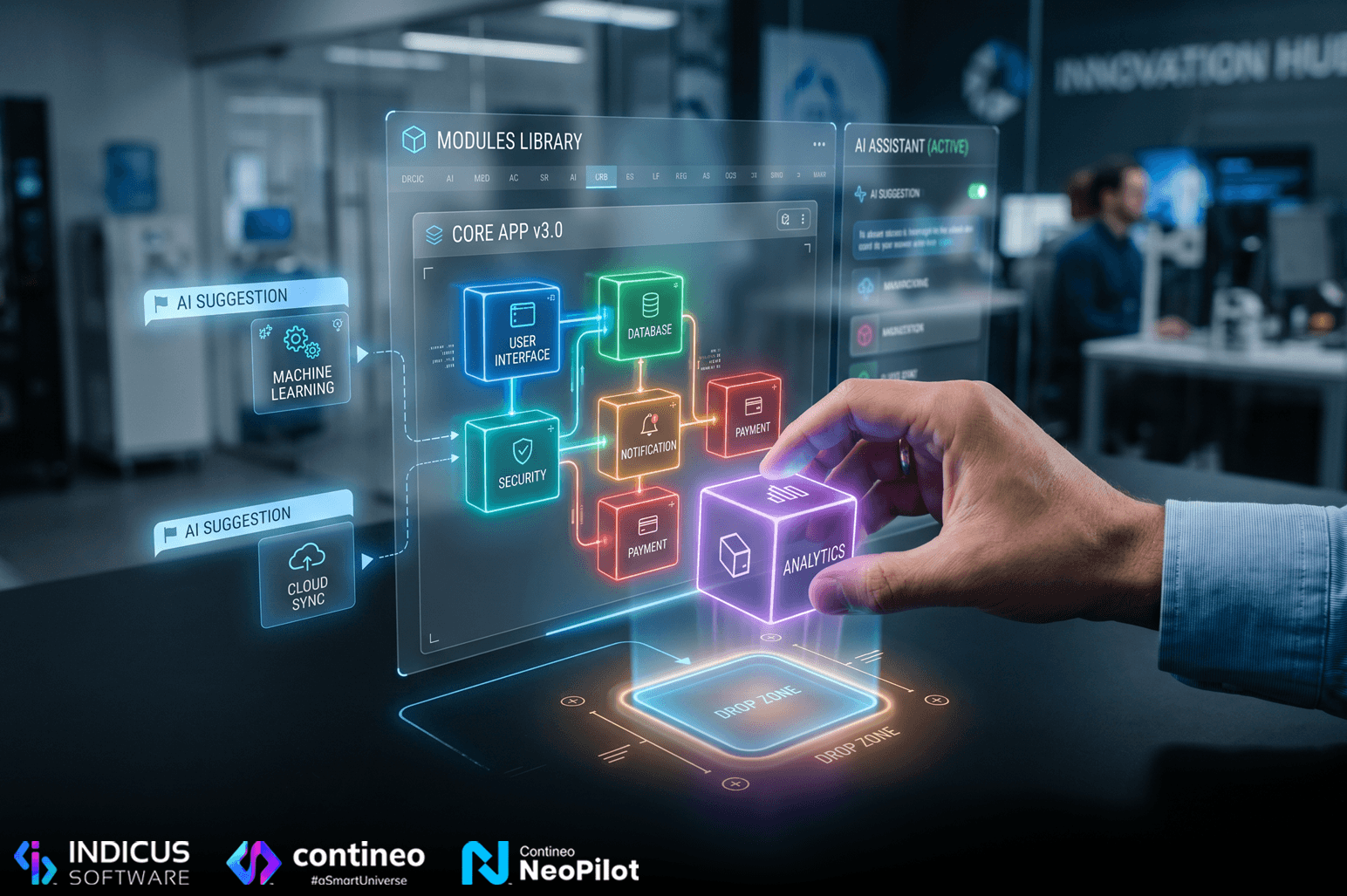
They provide visual development environments where applications can be designed using drag-and-drop interfaces. AI-powered automation enables workflows to execute tasks dynamically based on data and predefined rules. Predictive analytics allows organizations to identify patterns, forecast outcomes, and make proactive decisions.
Another important capability is conversational interaction, where users can interact with applications using natural language. This simplifies user experience and enhances accessibility across different user groups.
Integration is also a critical feature. These platforms can connect with enterprise systems such as ERP, CRM, IoT devices, and external APIs, enabling seamless data flow and unified operations.
From Automation to Intelligence: The Evolution of Low-Code Platforms
Low-code platforms initially focused on simplifying application development. However, with the integration of AI, they are evolving into intelligent systems capable of driving end-to-end business transformation.
This shift represents a move from static applications to dynamic systems that can analyze data, make decisions, and continuously improve in real time. AI-powered low-code platforms are enabling organizations to go beyond automation and build systems that can think, learn, and adapt.
This evolution is particularly important for enterprises looking to stay competitive in a rapidly changing environment.
Real-World Use Cases of AI-Powered Low-Code Platforms
AI-powered low-code platforms are already being used across industries to solve complex business challenges.
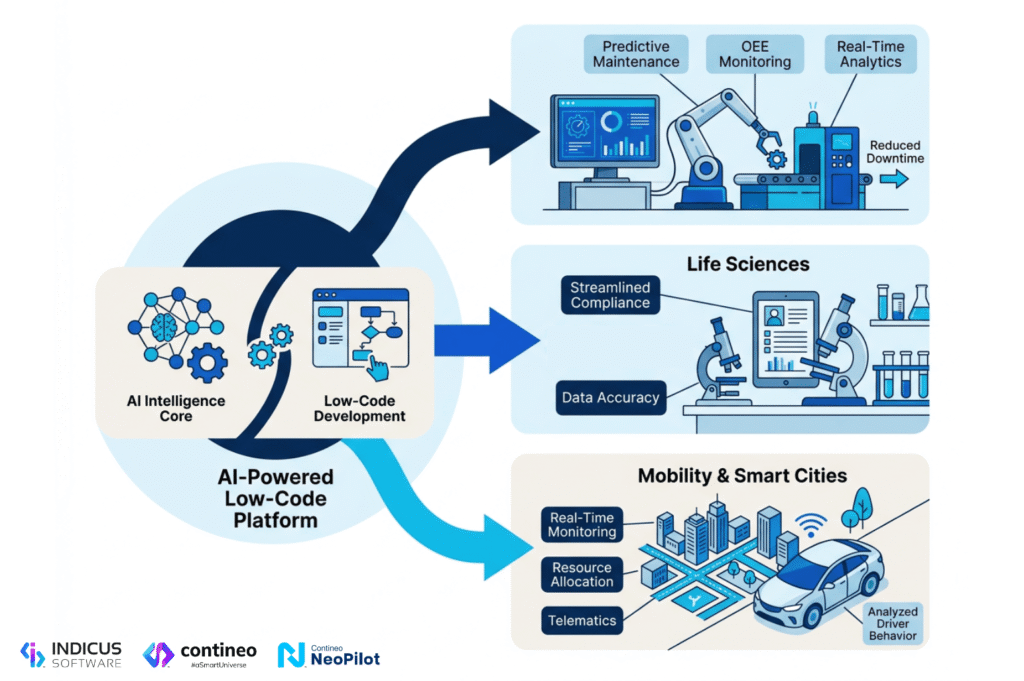
In manufacturing, organizations use these platforms for predictive maintenance, OEE monitoring, and real-time analytics, helping reduce downtime and improve efficiency. In life sciences, AI-driven low-code applications streamline compliance processes, automate quality management systems, and improve data accuracy.
In mobility and smart city solutions, AI-powered platforms enable real-time monitoring, intelligent resource allocation, and enhanced user experiences. Telematics systems leverage AI to analyze driver behavior, predict risks, and optimize fleet operations.
These real-world implementations demonstrate how AI-powered low-code platforms are enabling enterprises to build intelligent, scalable, and high-performance solutions
Challenges and Considerations
While AI-powered low-code platforms offer significant advantages, enterprises must also consider certain challenges.
Data quality plays a crucial role in the effectiveness of AI systems. Poor data can lead to inaccurate predictions and decisions. Integration with legacy systems may require careful planning to ensure seamless connectivity. Governance and security are also critical, as increased autonomy must be balanced with proper control and compliance.
However, these challenges can be addressed by choosing enterprise-grade platforms that offer robust architecture, security, and customization capabilities.
The Future of Enterprise Development
The future of enterprise development lies in the convergence of low code, artificial intelligence, and automation.
Organizations are moving toward building unified platforms where data, workflows, and intelligence are seamlessly integrated. AI-powered low-code platforms will play a central role in this transformation by enabling businesses to create applications that are not only efficient but also intelligent and adaptive.
As technology continues to evolve, these platforms will become the foundation of digital ecosystems, driving innovation, improving efficiency, and enabling new business models.
Why Contineo Leads the AI-Powered Low-Code Revolution
Contineo is at the forefront of this transformation by combining low-code, no-code capabilities with advanced AI-driven automation and enterprise-grade architecture.
Unlike traditional platforms that focus only on application development, Contineo enables organizations to build intelligent systems that integrate data, workflows, and AI into a unified environment. With GraphX, businesses can create agent-driven workflows where AI systems interact with users, automate tasks, and orchestrate processes across the organization.
Contineo’s ability to handle complex enterprise use cases, integrate with IoT systems, and support large-scale deployments makes it a powerful platform for organizations looking to adopt AI-powered low-code development.
By enabling faster development, intelligent automation, and seamless integration, Contineo is redefining what low-code platforms can achieve and positioning itself as a key driver of enterprise digital transformation
Final Thoughts
AI-powered low-code platforms represent the next phase of enterprise development. By combining speed, simplicity, and intelligence, they enable organizations to build evolving applications that are not only functional but also capable of learning, adapting, and evolving.
For enterprises aiming to stay ahead in the digital era, adopting AI-powered low-code platforms is no longer optional. It is a strategic necessity that will define the future of innovation and competitiveness.
Ready to transform your enterprise with AI-powered low-code platforms?
Discover how Contineo enables intelligent automation, faster application development, and scalable digital transformation.