Manufacturing has always evolved through technological revolutions. Mechanization introduced steam power. Electrification enabled mass production. Automation brought programmable machines and industrial robotics. Industry 4.0 connected machines through IoT, cloud computing, and real-time analytics.
Today, manufacturing is entering its next transformation.
The conversation is no longer about connecting machines. It is about enabling machines, systems, people, and AI to think, collaborate, and optimize operations together.
This is the era of AI-driven Smart Manufacturing.
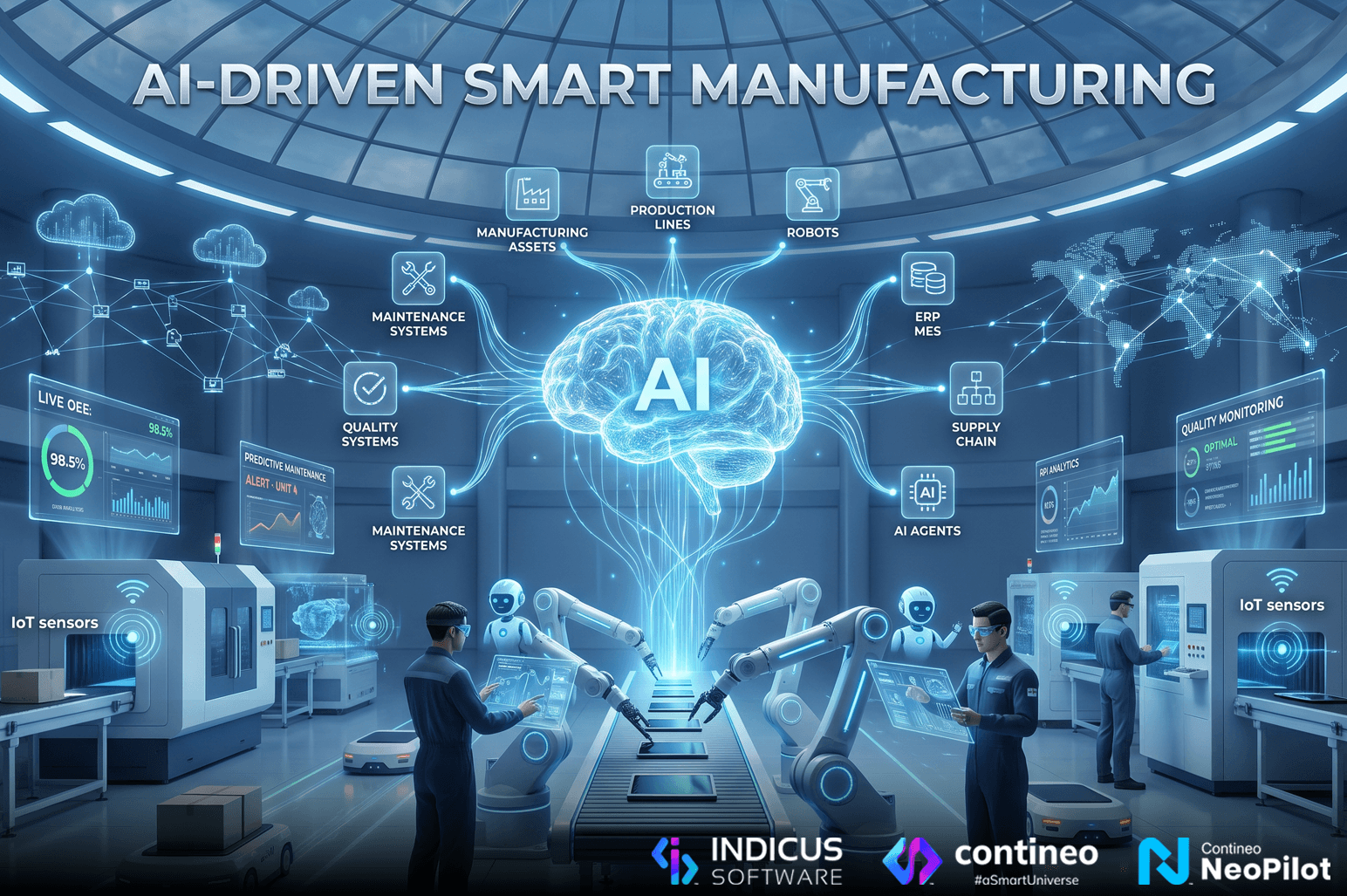
Unlike Industry 4.0, which focused on digital connectivity and data collection, AI-driven smart manufacturing focuses on operational intelligence. It transforms connected factories into adaptive, self-learning ecosystems capable of predicting problems, optimizing workflows, assisting human decision-makers, and continuously improving production performance.
For manufacturers facing rising operational costs, labor shortages, supply chain disruptions, and increasing customer expectations, AI is becoming a strategic capability rather than an experimental technology.
What is AI-Driven Smart Manufacturing?
AI-driven smart manufacturing is the integration of artificial intelligence, industrial IoT, enterprise software, automation, and operational data to create manufacturing environments that continuously learn, adapt, and improve.
Unlike traditional manufacturing systems that operate on predefined rules, AI-enabled systems analyze large volumes of production data, identify hidden patterns, predict operational outcomes, and recommend or execute actions in real time.
The objective is not simply automation.
The objective is autonomous operational intelligence.
In practical terms, AI-driven manufacturing enables factories to move from reactive operations toward predictive and proactive decision-making.
Beyond Industry 4.0: Why Manufacturers Need a New Operating Model
Industry 4.0 successfully digitized manufacturing operations by introducing connected machines, sensors, cloud platforms, and real-time monitoring. While these technologies significantly improved visibility, they also generated an enormous amount of operational data.
However, data alone does not improve productivity.
Many manufacturers now face a different challenge. Production data exists across MES systems, ERP platforms, quality management systems, maintenance software, IoT devices, spreadsheets, and operator logs. Although every system provides valuable information, they rarely work together intelligently.
As a result:
- Production managers spend valuable time searching for information instead of acting on insights.
- Maintenance teams react to failures instead of preventing them.
- Quality engineers investigate issues after defects occur.
- Executives receive reports that explain what happened but not why it happened or what should happen next.
AI addresses this challenge by transforming operational data into operational intelligence.
The Five Pillars of AI-Driven Smart Manufacturing
AI-driven manufacturing is built on five interconnected capabilities that extend far beyond traditional Industry 4.0 initiatives.
1. Predictive Intelligence
AI continuously analyzes equipment health, production trends, sensor data, and environmental conditions to predict failures before they occur.
Instead of responding to machine breakdowns, manufacturers can schedule maintenance based on actual equipment condition, reducing downtime and improving asset utilization.
2. Intelligent Quality Management
Traditional quality inspection often identifies problems after production is complete.
AI-powered vision systems and machine learning models detect anomalies during production, enabling manufacturers to identify root causes earlier and reduce defects before products reach customers.
3. Autonomous Workflow Orchestration
Manufacturing workflows involve production planning, maintenance approvals, inventory management, procurement, and compliance activities.
AI agents can automatically coordinate these workflows by analyzing operational conditions, routing approvals, triggering notifications, and recommending corrective actions without manual intervention.
4. Operational Decision Intelligence
Modern manufacturing generates millions of operational events every day.
AI systems aggregate information from production lines, enterprise applications, maintenance systems, supply chains, and quality platforms to provide contextual recommendations instead of isolated reports.
Rather than simply displaying dashboards, AI helps managers answer critical questions such as:
- Why is production efficiency declining?
- Which machine is most likely to fail next?
- Which production line creates the highest quality risk?
- What operational change will improve throughput?
5. Continuous Learning
Unlike traditional automation systems, AI continuously improves as more operational data becomes available.
Every maintenance event, production cycle, inspection report, and operator interaction contributes to a growing intelligence model that becomes increasingly accurate over time.
Why AI is Becoming Essential for Manufacturing Leaders
Manufacturers worldwide are facing unprecedented operational challenges.
Global competition demands faster innovation. Customers expect greater customization. Skilled labor shortages continue to increase. Supply chains remain volatile. Sustainability targets require greater operational efficiency.
Meeting these challenges with traditional manufacturing systems is becoming increasingly difficult.
AI enables manufacturers to optimize production while simultaneously improving flexibility, quality, and resource utilization.
Instead of relying solely on historical reports, operational leaders gain real-time recommendations that support faster and better decisions.
This transition represents a shift from data-driven manufacturing to intelligence-driven manufacturing.
From Connected Factories to Intelligent Factories
Many organizations describe themselves as smart factories because they have deployed IoT devices, connected machines, and digital dashboards.
However, connectivity alone does not create intelligence.
An intelligent factory is one where every operational component contributes to enterprise decision-making.
Machines communicate with enterprise systems.
AI agents coordinate workflows.
Knowledge is shared across departments.
Production continuously adapts based on operational conditions.
Employees collaborate with AI systems instead of manually interpreting disconnected reports.
This evolution transforms manufacturing from monitoring operations to optimizing operations autonomously.
The Missing Layer: Enterprise Intelligence
One of the biggest barriers to AI adoption in manufacturing is fragmented enterprise knowledge.
Production information often resides separately from maintenance records.
Quality systems operate independently from ERP platforms.
Engineering documents remain isolated from operational workflows.
As a result, AI systems struggle to understand operational context.
Modern manufacturing requires an intelligence layer capable of connecting production systems, enterprise applications, documents, workflows, people, and assets into a unified operational model.
Only then can AI deliver accurate recommendations across the entire manufacturing value chain.
How Contineo Accelerates AI-Driven Smart Manufacturing
Successful AI transformation requires more than deploying machine learning models. It requires an enterprise platform capable of connecting operations, workflows, and business systems.
Contineo enables manufacturers to build intelligent digital factories through its enterprise low-code platform, industrial IoT integration, workflow automation, and AI capabilities.
Manufacturers can rapidly develop applications for:
- Overall Equipment Effectiveness (OEE) monitoring
- Predictive maintenance
- Digital production logbooks
- Quality Management Systems (QMS)
- KPI analytics
- Chiller monitoring
- Industrial anomaly detection
- Smart maintenance workflows
- Production dashboards
Rather than replacing existing ERP, MES, or SCADA systems, Contineo integrates with enterprise infrastructure to unify operational data and automate business processes.
This enables manufacturers to accelerate digital transformation without disrupting existing operations.
Introducing GraphX: The Intelligence Layer for Smart Manufacturing
As AI adoption expands, manufacturers need more than connected applications.
They need connected intelligence.
GraphX is an enterprise knowledge graph and agent orchestration platform that serves as the intelligence layer for modern manufacturing environments.
Unlike conventional manufacturing platforms that manage isolated data, GraphX connects relationships between machines, production lines, maintenance records, quality events, operators, suppliers, enterprise systems, and AI agents.
This contextual understanding enables AI to move beyond simple automation.
With GraphX, manufacturers can:
- Connect structured and unstructured manufacturing knowledge.
- Build contextual AI agents that understand production relationships.
- Identify root causes across multiple operational systems.
- Enable AI agents to collaborate across departments.
- Create continuously evolving manufacturing intelligence.
Instead of simply monitoring operations, GraphX helps organizations build factories that learn, reason, and improve continuously.
The Future of Manufacturing is Collaborative Intelligence
The factories that lead the next decade will not necessarily have the most machines or the most data.
They will have the most intelligent operations.
Applications will continue to manage production.
Industrial IoT will continue collecting operational data.
AI agents will automate workflows and generate recommendations.
Knowledge graphs will provide the contextual intelligence that connects everything together.
Human expertise will remain essential, but it will increasingly be augmented by AI systems capable of processing complexity at unprecedented scale.
The future of manufacturing is no longer defined by Industry 4.0.
It is defined by connected intelligence, autonomous operations, and continuous learning.
Organizations that embrace AI-driven smart manufacturing today will build more resilient, efficient, and competitive factories for tomorrow.
Transform Your Factory into an Intelligent Enterprise
AI-driven smart manufacturing is no longer a future vision it is becoming a competitive necessity.
With Contineo, manufacturers can rapidly digitize operations, automate workflows, integrate enterprise systems, and build scalable manufacturing applications. Combined with GraphX, organizations gain an enterprise intelligence layer that enables AI agents, connected knowledge, and contextual decision-making across the factory.
Whether your goal is predictive maintenance, intelligent quality management, production optimization, or enterprise-wide operational intelligence, Contineo and GraphX provide the foundation for the next generation of smart manufacturing.
Explore how Contineo and GraphX can accelerate your manufacturing transformation and help you move beyond Industry 4.0 toward truly intelligent operations.