Executive Audience
This blog is written for CEOs, CXOs, CTOs, CIOs, Heads of Digital Transformation, Operations Leaders, and Enterprise Decision Makers responsible for scaling AI, automation, and digital initiatives across the organization.
The Shift No One Can Ignore
For more than a decade, enterprises have invested heavily in automation. From RPA bots to workflow engines, the goal was simple: reduce manual effort and improve efficiency.
Yet in 2026, a growing number of organizations are realizing a hard truth:
traditional automation is no longer enough.
Despite significant investments, many automation initiatives are hitting a ceiling. Processes break when conditions change. Systems struggle with exceptions. Teams rebuild similar workflows repeatedly across departments.
The result is rising costs, fragmented systems, and limited scalability.
A new paradigm is emerging to address this gap:
Multi Agent AI.
What is Multi Agent AI
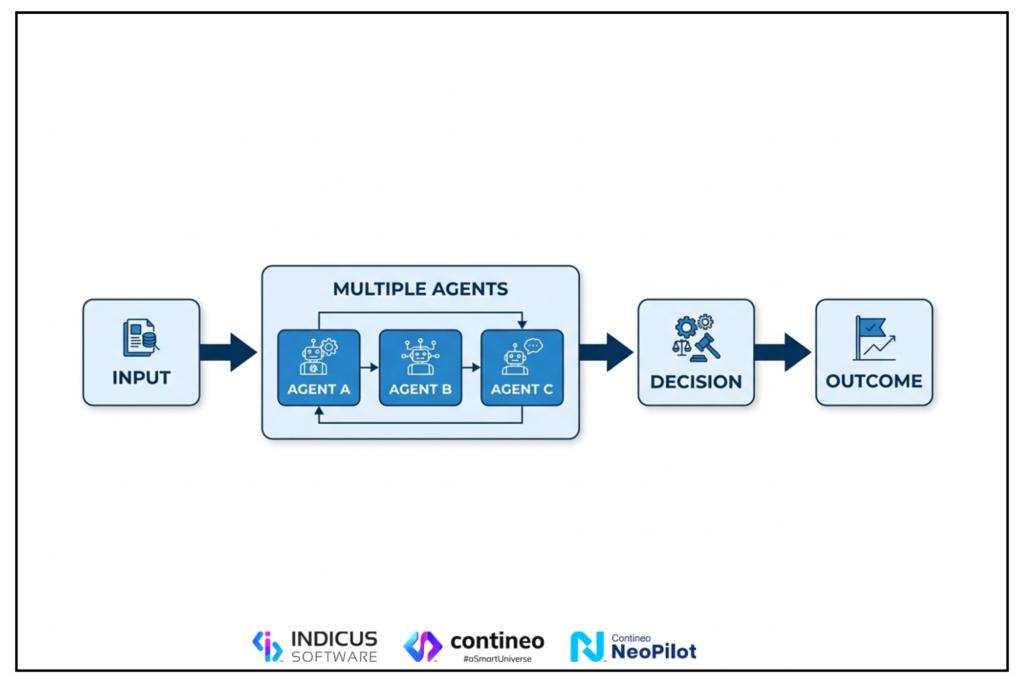
Multi Agent AI refers to systems where multiple intelligent agents collaborate, communicate, and dynamically execute tasks across workflows.
Unlike traditional automation, which follows predefined rules, agent based systems are:
- Context aware
- Adaptive to changing inputs
- Capable of decision making
- Able to coordinate across systems and teams
- Outcome driven, focusing on achieving business results rather than just completing tasks
Instead of automating tasks, these systems orchestrate outcomes.
Why Traditional Automation is Reaching Its Limits
1. Rule Based Systems Cannot Handle Complexity
Traditional automation relies on predefined logic. This works well for repetitive and predictable processes.
However, real world enterprise operations are rarely predictable. Exceptions, variations, and unstructured data and human intervention create constant friction.
As a result, teams spend more time maintaining automation than benefiting from it.
2. Fragmented Automation Across Teams
In most enterprises, different departments build their own automation:
- Marketing builds campaign workflows
- Operations builds process automation
- Finance builds reporting pipelines
Each system operates in isolation, leading to duplication and inefficiency.
The same problem is solved multiple times, in multiple ways.
3. Lack of Intelligence and Decision Making
Traditional systems execute tasks. They do not think.
They cannot:
- Analyze context deeply
- Make judgment based decisions
- Adapt workflows dynamically
This creates a dependency on human intervention, limiting scalability.
4. Increasing Cost Without Proportional Value
As automation expands, so does complexity.
Maintaining multiple tools, workflows, and integrations increases operational overhead.
Organizations are now asking:
Why are costs rising, but outcomes not improving?
Enter Multi Agent AI: A New Operating Model
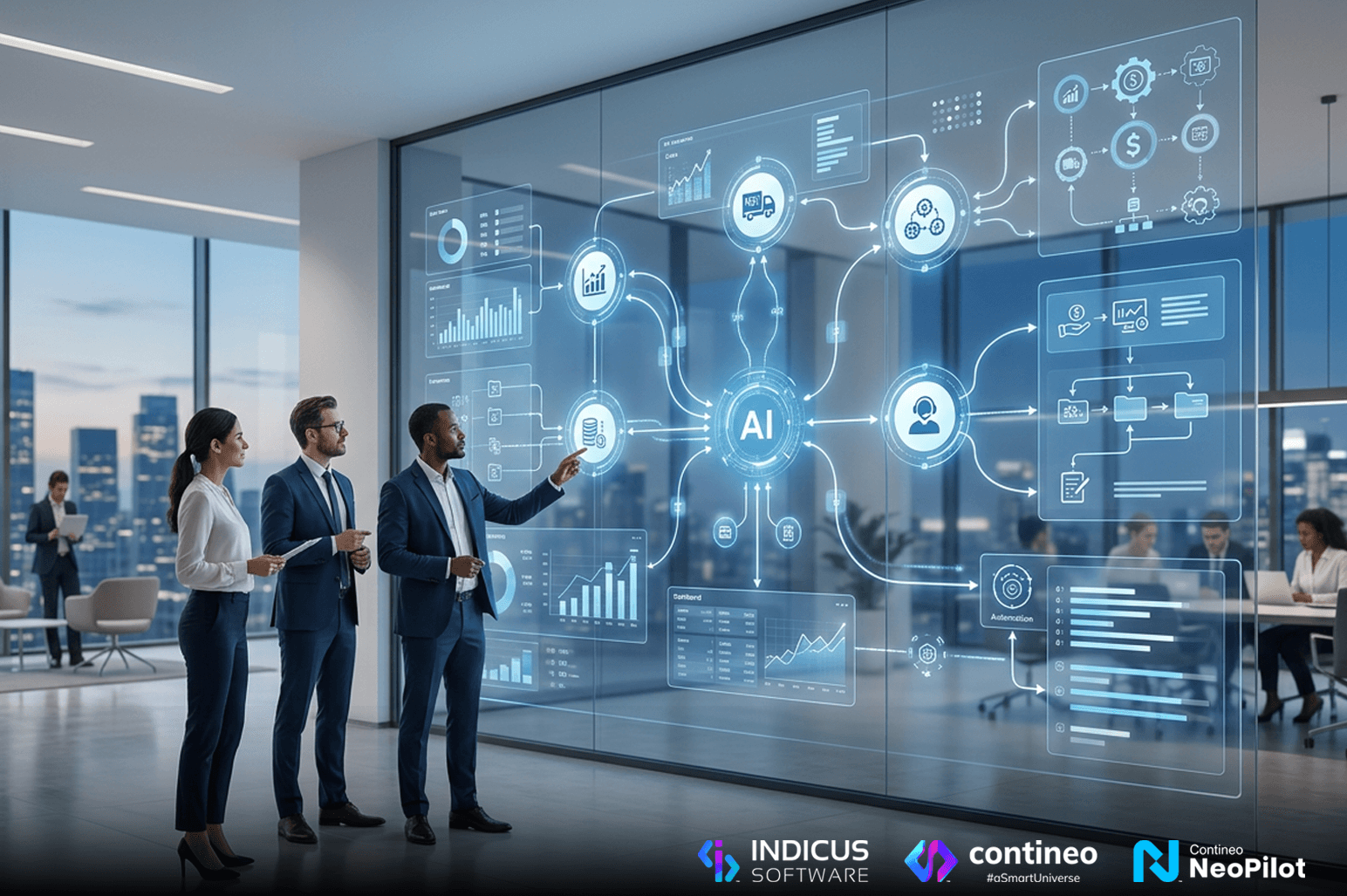
Multi Agent AI addresses these challenges by shifting from task automation to intelligent orchestration.
Key Capabilities
1. Autonomous Decision Making
Agents can analyze data, interpret context, and decide the next best action without human intervention.
2. Dynamic Workflow Adaptation
Instead of rigid workflows, agents adjust processes in real time based on conditions.
3. Cross System Coordination
Agents can interact across multiple systems, APIs, and data sources seamlessly.
4. Continuous Learning and Evolution
Unlike static automation, agent based systems improve over time.
From Automation to Intelligence: A Practical Example
Consider a manufacturing enterprise.
Traditional Approach
- OEE dashboards track performance
- Alerts notify issues
- Teams manually analyze and act
Multi Agent AI Approach
- One agent monitors machine data in real time
- Another agent analyzes anomalies and predicts failures
- A third agent triggers maintenance workflows
- A coordination agent ensures alignment across production, maintenance, engineering, and supply chain
The outcome is not just visibility, but autonomous optimization.
Industry Momentum: Why 2026 is the Inflection Point
Several forces are accelerating the shift toward Multi Agent AI:
- Explosion of Enterprise Data
IoT, enterprise systems, and digital platforms / digital transformation are generating massive volumes of data. Static automation cannot keep up.
- Advances in Generative AI
Large language models and AI reasoning capabilities are enabling systems to understand context and take actions.
- Demand for Real Time Decision Making
Businesses can no longer rely on delayed insights. Decisions must happen instantly.
- Pressure to Do More With Less
Organizations need to scale operations without increasing headcount.
Where Multi Agent AI Delivers the Most Value
Manufacturing and Industrial Operations
- Predictive maintenance
- OEE optimization
- Energy efficiency monitoring
Mobility and Telematics
- Driver behavior analytics
- Real time alerts and risk detection
- Fleet optimization
Life Sciences and Compliance
- Digital logbooks
- Quality management workflows
- Audit ready systems
Retail and Smart Systems
- Smart inventory management
- Customer behavior insights
- Automated replenishment
Across industries, the pattern is clear:
systems are moving from reactive to proactive to autonomous.
The Missing Piece: Why Technology Alone is Not Enough
While many organizations are experimenting with AI, few are achieving scale.
The reason is not the lack of models.
It is the lack of a unified platform.
To truly leverage Multi Agent AI, enterprises need:
- A strong data foundation
- Seamless integration across systems
- A flexible application layer
- Built in orchestration capabilities
Without this, AI remains fragmented and underutilized.
How Contineo Enables Multi Agent AI at Scale
Contineo is designed to bridge this gap by combining:
1. Low Code No Code Platform
Rapidly build and deploy enterprise applications without heavy development cycles.
2. Agentic AI Orchestration
Create, deploy, and manage intelligent agents that collaborate across workflows.
3. Unified Data and Workflow Layer
Integrate data from multiple sources and enable real time decision making.
4. Pre Built Enterprise Use Cases
From manufacturing analytics to compliance systems, accelerate time to value with ready solutions.
What Makes Contineo Different
Unlike traditional platforms, Contineo is not just a development tool.
It is an enterprise intelligence layer that enables:
- Self evolving applications
- Cross functional coordination
- Scalable AI driven operations
This allows organizations to move from isolated automation to connected intelligence.
Business Impact: What Leaders Can Expect
Organizations adopting Multi Agent AI through platforms like Contineo are seeing:
- Faster decision making across operations
- Reduced manual intervention
- Lower operational costs
- Improved efficiency and productivity
- Greater scalability without proportional increase in resources
Most importantly, they are building systems that continuously improve over time.
The Road Ahead
The shift from automation to Multi Agent AI is not a trend.
It is a structural transformation in how enterprises operate.
Just as cloud redefined infrastructure and data redefined decision making,
agent based systems will redefine execution.
Organizations that embrace this shift early will gain a significant competitive advantage.
Those that delay risk being constrained by outdated systems.
Final Thought
The question is no longer:
Should you adopt AI?
The real question is:
Can your current systems support intelligent, scalable, and adaptive operations?
If the answer is no, the time to act is now.
Explore What’s Possible
Contineo are helping enterprises move beyond automation and build truly intelligent systems.
If you are looking to:
- Scale AI across your organization
- Replace fragmented automation with unified intelligence
- Build future ready operations
It is time to explore a new approach.
Connect with us to see how multi-agent AI can transform your enterprise.
Ready to move beyond traditional automation? Discover how Multi Agent AI can transform your enterprise operations with Contineo