Across boardrooms and leadership discussions, one question is becoming unavoidable.
Why do so many artificial intelligence initiatives stall, even after heavy investments in cloud migration, data platforms, and analytics tools?
The problem is rarely a lack of data.
Enterprises today generate massive volumes of data across cloud platforms, on prem systems, edge devices, IoT networks, SaaS applications, and partner ecosystems. Yet despite this abundance, business leaders struggle to extract timely, reliable, and actionable intelligence.
The core issue is fragmentation.
Data exists everywhere, but insight exists nowhere.
This is precisely where a data fabric becomes critical, not as another tool, but as a fundamentally different architectural approach for the AI driven enterprise.
What Is a Data Fabric?
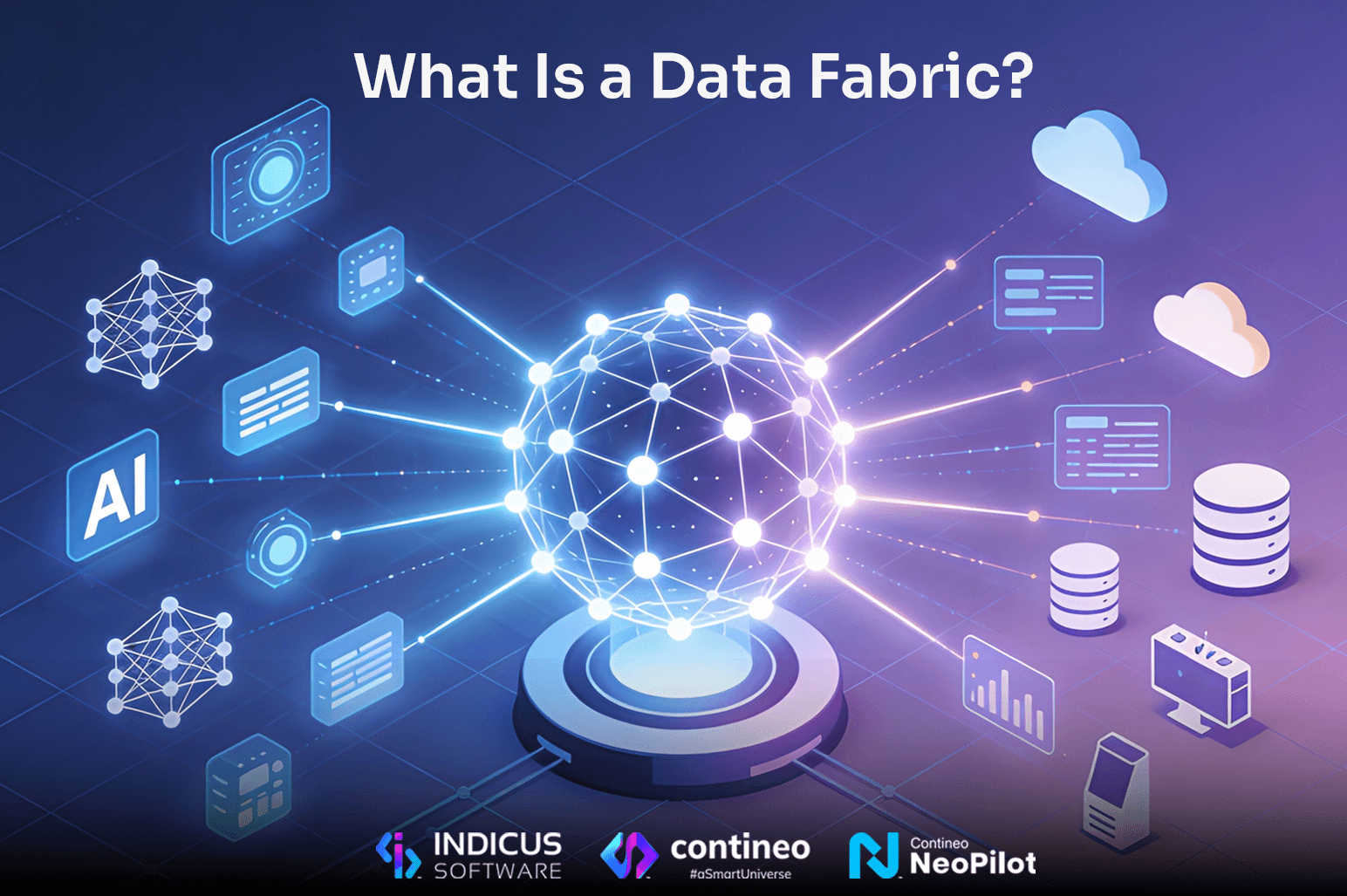
A data fabric is an architectural approach and a set of technologies that creates a unified and consistent layer to access, manage, and govern disparate data across an organization’s entire landscape, including cloud, on prem, and edge environments.
Rather than physically moving all data into a single repository, a data fabric uses automation, metadata, and AI and ML to intelligently connect, integrate, clean, and secure data in real time. This enables organizations to deliver what many industry leaders describe as a single source of truth for analytics, AI, and operational use cases, without centralizing all data in one location.
This definition closely aligns with how global technology leaders such as Hewlett Packard Enterprise, IBM, and SAP describe data fabric today. It also mirrors how Google AI Overviews increasingly summarize authoritative answers on the topic.
Think of a data fabric as an intelligent, invisible weave stretched across all your data sources. It understands what data exists, where it lives, how it is structured, how it is governed, and how it should be consumed.
Why Do Traditional Data Architectures Fail AI?
Most enterprises approach AI using legacy data thinking.
They attempt to centralize everything into large data lakes or warehouses. They build rigid data pipelines that take months to deploy. They depend heavily on manual data engineering and governance processes. And they struggle to keep pace with real time operational needs.
This model breaks down for three fundamental reasons.
First, AI requires context, not just volume. Models need relationships, lineage, quality, and meaning, not just rows and columns.
Second, AI demands speed and adaptability. Static pipelines cannot respond to evolving business questions, regulatory changes, or new data sources.
Third, AI depends on trust. Without consistent governance, security, and metadata, AI outputs cannot be relied upon for strategic decisions.
A data fabric directly addresses all three challenges.
Core Components of a Modern Data Fabric
Although implementations differ, mature data fabric architectures share several essential capabilities.
Unified Access Across All Data Sources
A data fabric connects data wherever it resides. Cloud data lakes, enterprise databases, SaaS applications, IoT streams, edge systems, and legacy platforms all become accessible through a consistent interface.
For business users and AI systems, this eliminates the need to understand where data lives. They simply request what they need.
Metadata Driven Intelligence
Metadata serves as the engine of a data fabric. It captures technical metadata such as schema and lineage, business metadata such as definitions and ownership, and operational metadata such as usage and performance.
This intelligence allows the fabric to understand, integrate, and govern data automatically, rather than manually.
Data Integration and Virtualization
Instead of physically moving data, a data fabric often relies on virtualization to access data in place. This reduces latency, cost, and risk, while still enabling unified analytics and AI consumption.
Automation at Enterprise Scale
Data ingestion, transformation, quality validation, policy enforcement, and lifecycle management are automated using rules and machine learning. This dramatically reduces operational complexity and human dependency.
Governance and Security by Design
A data fabric enforces consistent access controls, compliance requirements, and auditability across the entire data landscape. Governance is embedded into the architecture, not added later.
AI and ML Enablement
Most importantly, a data fabric prepares and delivers high quality, trusted, AI ready data to machine learning models, analytics platforms, and autonomous agents.
How Does a Data Fabric Work in Practice?
- At a simplified level, a data fabric operates in four continuous stages.
- It connects to diverse data sources such as databases, APIs, cloud storage, and operational systems.
- It understands data using metadata to build a living map of relationships, meaning, lineage, and quality.
- It governs and secures data by applying consistent access, security, and compliance policies.
- It delivers data through APIs, self service tools, analytics platforms, and AI pipelines in real time.
- As data sources evolve and business needs change, the fabric adapts continuously.
Why Does a Data Fabric Matter for AI?
AI initiatives rarely fail because of algorithms. They fail because of data.
A data fabric fundamentally changes the economics and feasibility of enterprise AI. It accelerates time to insight by eliminating months of manual data preparation. It improves model accuracy by ensuring consistent, governed, and high quality data. It enables real time intelligence by unifying operational and analytical data. It allows AI to scale across the enterprise, rather than remaining trapped in isolated pilots.
This is why data fabric is being identified as a foundational requirement for successful AI adoption.
The Critical Gap in Most Data Fabric Strategies
Despite its promise, many data fabric initiatives fail to deliver meaningful business outcomes.
Why?
Because they stop at data.
A truly AI driven enterprise requires not just unified data, but intelligent action.
Most platforms focus on connectivity and metadata, but lack the ability to orchestrate workflows, build applications, and deploy AI agents directly on top of the fabric.
This is the gap where real value is lost.
How Contineo Redefines the Data Fabric for AI
Contineo was designed for this next phase of enterprise intelligence.
Contineo is not just a data fabric. It is an AI native enterprise platform where data fabric, application development, and agentic AI operate as one system.
Contineo creates a unified and consistent data layer across IoT systems, enterprise applications, cloud platforms, and edge environments using advanced metadata driven models.
Its knowledge graph based architecture ensures data is contextual, relational, and AI ready.
With NeoPilot, enterprises can build AI agents that reason, act, and learn using the data fabric as their foundation. These agents do not merely analyze data. They execute workflows, generate applications, and drive operational outcomes.
Through low code and no code capabilities, business and IT teams collaborate to build dashboards, workflows, analytics, and AI powered applications directly on the fabric, without compromising governance, security, or scale.
This architecture is already trusted in mission critical industries such as manufacturing, mobility, life sciences, and smart infrastructure.
The Strategic Imperative
The enterprises that succeed with AI will not be those with the largest models or the most data.
They will be the ones with the most intelligent data foundation.
A data fabric provides that foundation. When combined with application development, workflow orchestration, and agentic AI, it unlocks exponential value.
This is the future Contineo is already delivering.
Ready to Build an AI Ready Enterprise?
If you are looking to move from fragmented data and isolated AI pilots to a unified, intelligent enterprise platform, the Contineo team can help.
Talk to us today to see how Contineo’s AI driven data fabric can power your next phase of digital transformation.