Digital transformation is no longer a question of ambition. It is a question of execution.
Across industries, boards and executive teams agree on the urgency to modernize operations, improve efficiency, and unlock value from data. Yet despite years of investment, many enterprises find themselves stuck with fragmented systems, slow delivery cycles, and isolated digital pilots that never scale.
This gap between intent and impact defines the need for a new operating model. One that prioritizes speed, adaptability, and scale. This is the new era of digital agility.
Why Traditional Digital Transformation Is Breaking Down
For years, enterprises pursued digital transformation through large, multi year programs. These initiatives aimed to modernize core systems, replace legacy applications, and standardize processes across the organization.
In practice, this approach often failed.
Projects became complex and expensive. Business needs changed faster than systems could be delivered. Custom development created rigid architectures that were difficult to adapt. As a result, transformation became an ongoing initiative rather than a measurable outcome.
The fundamental issue is that traditional models were designed for stability, not change.
In today’s environment, enterprises must respond to volatile markets, regulatory shifts, supply chain disruptions, and evolving customer expectations. This requires technology that can evolve continuously, not platforms that lock organizations into fixed roadmaps.
What Digital Agility Really Means
Digital agility is the ability of an enterprise to rapidly design, deploy, modify, and scale digital solutions as business conditions change.
It goes beyond digitizing existing processes. It enables organizations to experiment quickly, learn from real usage, and expand successful solutions across the enterprise.
Digitally agile organizations share three characteristics.
They deliver value in weeks, not years.
They adapt solutions without rewriting systems.
They scale successful use cases into enterprise platforms.
This shift requires a fundamentally different approach to technology architecture.
The Start Small, Finish Big Strategy
Leading enterprises have adopted a clear and pragmatic pattern.
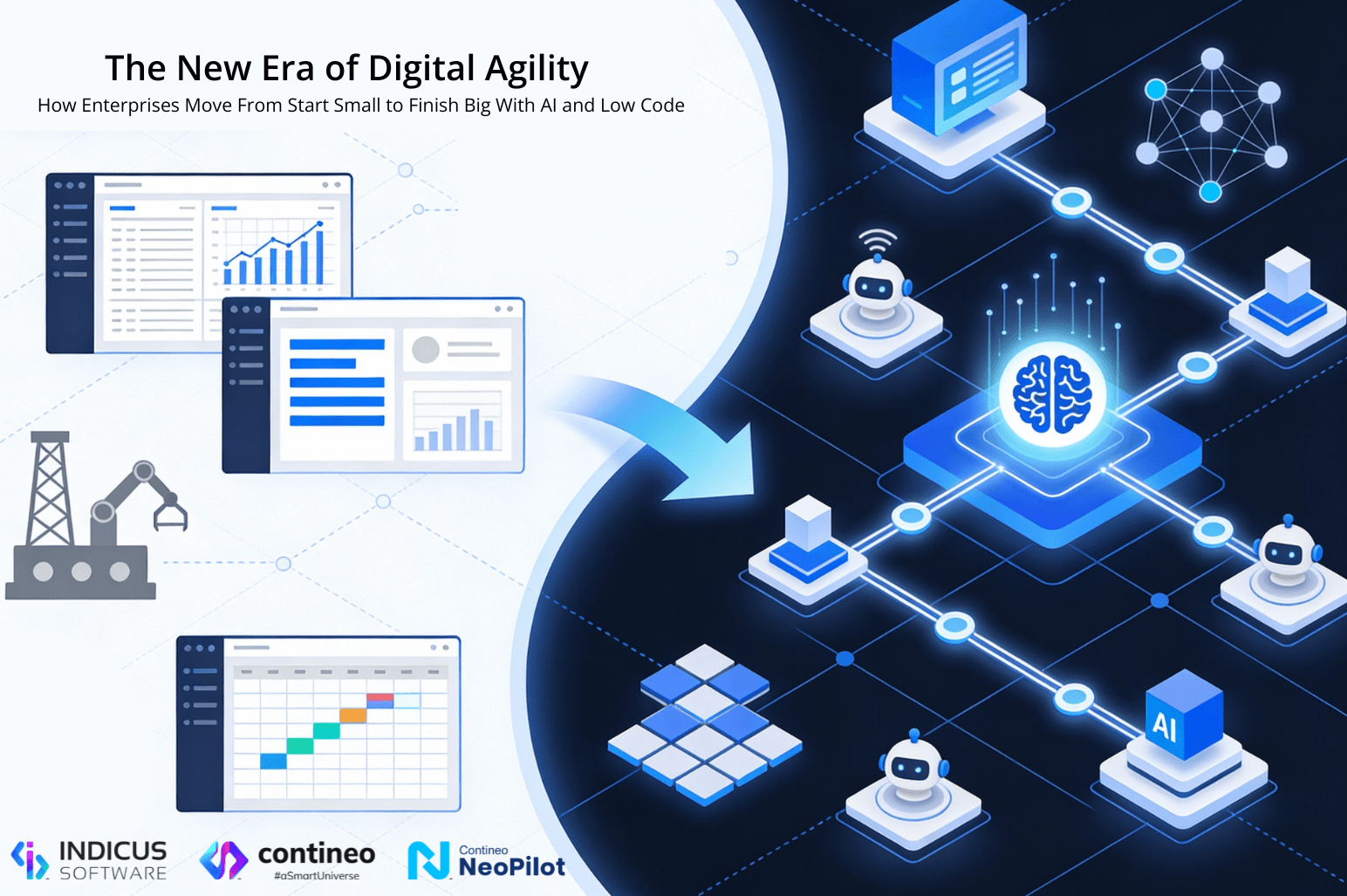
They start small with focused, high-impact use cases that solve real operational problems. These could include OEE monitoring in a manufacturing plant, telematics analytics for fleet operations, or digital logbooks in regulated environments.
These initial deployments are intentionally narrow in scope. The objective is speed, validation, and measurable ROI.
Once value is proven, enterprises finish big by expanding the same foundation across plants, departments, and geographies. New workflows, analytics, and integrations are added incrementally, without rebuilding the core system.
The critical enabler of this strategy is technology that supports both experimentation and scale.
Why AI and Low Code Are Central to Digital Agility
Two technology shifts have fundamentally changed what is possible.
The first is low code and no code platforms. These platforms dramatically reduce the time and effort required to build applications, workflows, and dashboards. Business teams and IT can collaborate to deliver solutions without long development cycles.
The second is AI and agentic automation. AI moves digital solutions beyond visibility and reporting. It enables systems to analyze patterns, predict outcomes, and take action autonomously.
When combined, AI and low code platforms allow enterprises to move from static applications to intelligent systems that evolve continuously.
This combination transforms digital initiatives from one time projects into living platforms.
From Dashboards to Decisions
One of the most common failure points in digital transformation is over reliance on dashboards.
Enterprises invest heavily in analytics and KPI reporting, yet decision making remains manual. Insights are generated, but action is slow or inconsistent.
Digitally agile enterprises close this gap.
They embed intelligence directly into workflows. AI agents monitor operational data, detect anomalies, and trigger actions automatically. Low code tools allow teams to adjust processes quickly as conditions change.
This shift from reporting to execution is where real value is created.
Scaling Digital Agility Across the Enterprise
Starting small is easy. Scaling is not.
Many organizations struggle to expand successful pilots because underlying architectures cannot support growth. Data models are inconsistent. Governance breaks down. Custom code becomes difficult to maintain.
Digital agility at scale requires a unified foundation.
This foundation must support data fabric, application development, workflow orchestration, and AI on a single platform. It must enable flexibility without compromising security, compliance, or performance.
This is where most traditional platforms fall short.
How Contineo Enables Digital Agility at Enterprise Scale
Contineo was designed specifically to support the start small, finish big journey.
Contineo combines low code application development, AI driven automation, and a unified data fabric into one enterprise grade platform. This allows organizations to build solutions quickly while maintaining architectural consistency.
Initial use cases can be deployed rapidly using pre built models and workflows. As adoption grows, the same platform scales across operations, integrating IoT data, enterprise systems, and external services.
With agentic AI capabilities, enterprises move beyond automation to intelligent execution. Systems do not just support users. They actively assist, recommend, and act.
Most importantly, Contineo ensures governance by design. Security, compliance, and quality are embedded into the platform, enabling business teams to innovate safely.
Who Digital Agility Is For
Digital agility is no longer a concern limited to IT leaders.
It matters most to:
CEOs and Managing Directors driving growth and resilience
CXOs responsible for transformation and operational excellence
Chief Data and AI Officers seeking scalable AI adoption
Heads of Manufacturing, Mobility, and Regulated Operations
Enterprise Architects planning future ready platforms
For these leaders, digital agility is not a technology trend. It is a strategic capability.
The Strategic Imperative for Leaders
The enterprises that succeed in the next decade will not be those with the largest transformation budgets or the most ambitious roadmaps.
They will be those that learn fastest, adapt continuously, and scale intelligently.
The path forward is clear.
Start small with focused, high-value use cases.
Build on platforms designed for change.
Finish big by scaling proven solutions across the enterprise.
In the new era, digital agility is not optional. It is the foundation of sustainable competitive advantage.
Discover how AI and low code can accelerate digital agility across your enterprise.