AI reasoning refers to the ability of artificial intelligence systems to process information, make logical connections, and arrive at conclusions through structured thinking processes. Unlike simple pattern matching, reasoning involves multi-step cognitive processes that mirror human problem-solving approaches.
Simple vs. Reasoning AI
Simple Pattern Matching:
Question: “What is 15 + 27?”
Answer: “42” (direct recall)
Reasoning Process:
Question: “If I have 15 apples and buy 27 more, then give away 8 to friends, how many do I have left?”
Steps: 15 + 27 = 42 → 42 – 8 = 34 → Answer: “34 apples”
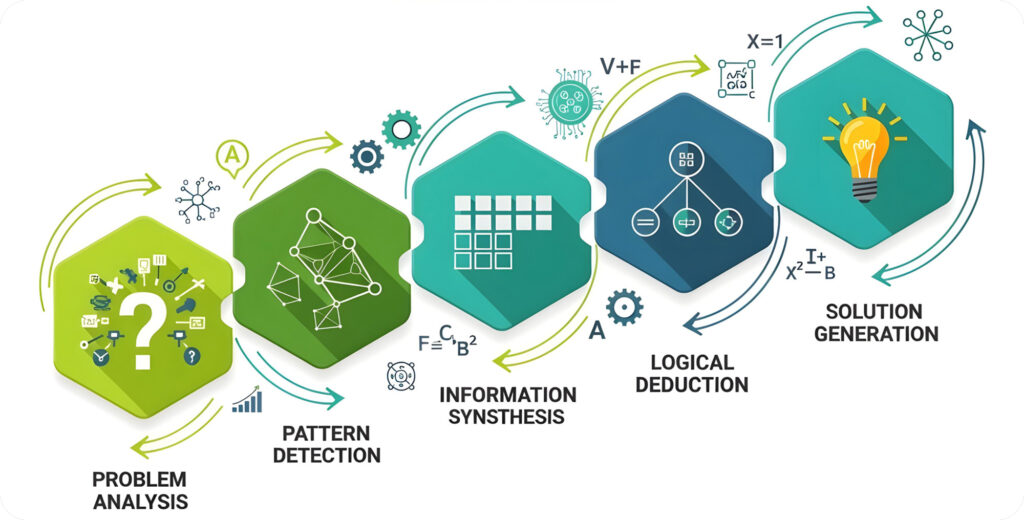
The Chain-of-Thought Revolution
One of the most significant breakthroughs in AI reasoning came from the groundbreaking paper “Chain-of-Thought Prompting Elicits Reasoning in Large Language Models” by Wei et al. from Google Research (2022). This research demonstrated that large language models can perform complex reasoning when prompted to generate intermediate steps.
Research Citation: Wei, J., Wang, X., Schuurmans, D., Bosma, M., Ichter, B., Xia, F., Chi, E., Le, Q. V., & Zhou, D. (2022). Chain-of-thought prompting elicits reasoning in large language models. Advances in Neural Information Processing Systems, 35, 24824-24837.
Chain-of-Thought Example:
Q: Roger has 5 tennis balls. He buys 2 more cans of tennis balls. Each can has 3 tennis balls. How many tennis balls does he have now?
A: Roger started with 5 balls. 2 cans of 3 tennis balls each is 6 tennis balls. 5 + 6 = 11. The answer is 11.
Technical Mechanism
Chain-of-thought prompting works by decomposing complex problems into intermediate steps, allowing models to allocate additional computation to problems requiring more reasoning. This approach showed remarkable improvements across arithmetic, commonsense, and symbolic reasoning tasks.
Standard Prompting
GSM8K Math Performance: 17.9%
Direct answer generation without intermediate steps
Chain-of-Thought
GSM8K Math Performance: 56.9%
Step-by-step reasoning with intermediate calculations
System 1 vs. System 2 Thinking in AI
Drawing from cognitive psychology research by Daniel Kahneman, AI researchers have begun implementing dual-process theories in artificial systems. Recent research, including the comprehensive survey “From System 1 to System 2: A Survey of Reasoning Large Language Models” by Li et al. (2025), explores how AI can transition between fast, intuitive responses and slow, deliberate reasoning.
System 1 Thinking
✅ Fast and intuitive
✅ Pattern recognition
✅ Automatic responses
❌ Limited reasoning depth
System 2 Thinking
✅ Deliberate and logical
✅ Multi-step reasoning
✅ Error correction
❌ Slower and more expensive
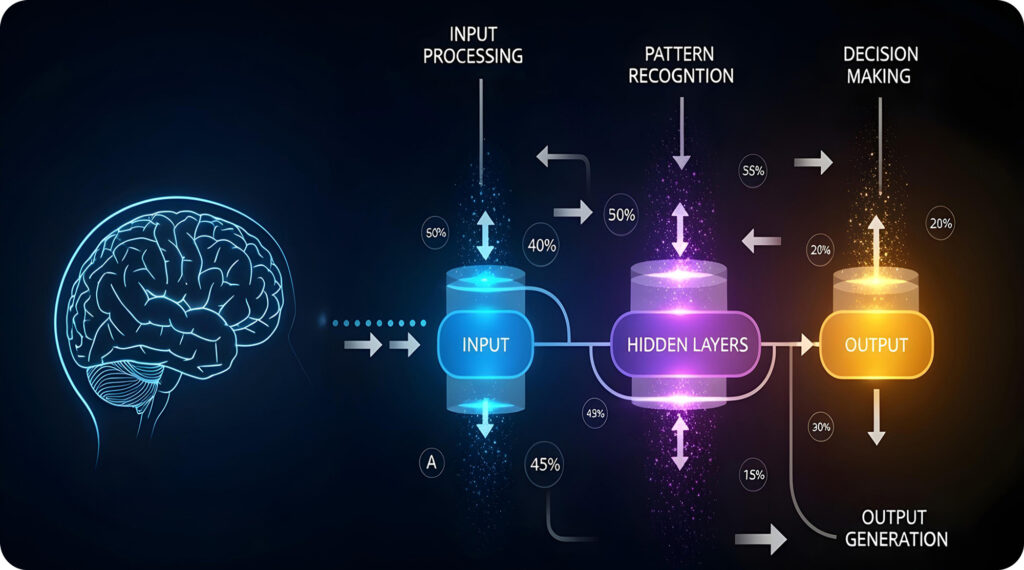
Example: OpenAI’s o1 Model
See how OpenAI’s o1 model uses System 2 thinking!
o1 Model Reasoning Process:
1. Problem Analysis: Break down the question into components
2. Strategy Formation: Develop multiple approaches
3. Step-by-step Execution: Work through each step methodically
4. Self-correction: Verify and adjust reasoning
5. Final Answer: Provide conclusion with confidence
This process can take 10-60 seconds compared to 1-2 seconds for standard models
Research Citation: Li, Z. Z., et al. (2025). From System 1 to System 2: A Survey of Reasoning Large Language Models. arXiv preprint arXiv:2502.17419.
Neural-Symbolic AI: The Best of Both Worlds
Recent research in neural-symbolic AI, as outlined in the systematic review “Neuro-Symbolic AI in 2024” by Colelough & Regli (2025), combines the pattern recognition capabilities of neural networks with the logical reasoning of symbolic systems.
🔗 Neural-Symbolic Integration
Neural Component: Processes raw data, recognizes patterns
+
Symbolic Component: Applies logical rules, enables reasoning
=
Enhanced AI System: Combines perception with reasoning
Research Citation: Colelough, B. C., & Regli, W. (2025). Neuro-Symbolic AI in 2024: A Systematic Review. arXiv preprint arXiv:2501.05435.
Key Advantages of Neural-Symbolic Approaches
- Explainability: Can provide clear reasoning paths
- Data Efficiency: Requires less training data
- Logical Consistency: Maintains coherent reasoning
- Adaptability: Can incorporate new knowledge easily
The Technical Architecture of Reasoning
Modern reasoning systems employ several key technical components:
Reasoning Architecture Components
1. Attention Mechanisms: Focus on relevant information across reasoning steps
2. Working Memory: Maintain intermediate states during reasoning
3. Planning Modules: Generate and evaluate reasoning strategies
4. Verification Systems: Check logical consistency and accuracy
5. Knowledge Integration: Combine learned and explicit knowledge
Reinforcement Learning in Reasoning
Research on OpenAI’s o1 model reveals the crucial role of reinforcement learning in developing reasoning capabilities. The model is trained using RL techniques where it learns to improve its reasoning process through trial and error, receiving rewards for correct solutions and logical consistency.
**RL Training Process:**1. Generate multiple reasoning paths2. Evaluate each path for correctness3. Reward logical and accurate reasoning4. Update model to prefer better reasoning strategies5. Iterate to improve reasoning quality
The Future of AI Reasoning
Research continues to push the boundaries of AI reasoning capabilities. Future developments may include:
Emerging Trends
- Multimodal Reasoning: Combining text, images, and other data types
- Continuous Learning: Reasoning systems that improve over time
- Causal Reasoning: Understanding cause-and-effect relationships
- Meta-Reasoning: Reasoning about reasoning processes
- Collaborative Reasoning: Multiple AI systems working together
Key Research Areas: Current research focuses on developing more efficient reasoning algorithms, improving interpretability, and creating systems that can reason across multiple domains and modalities.
Conclusion
AI reasoning represents one of the most exciting frontiers in artificial intelligence research. From the foundational work on Chain-of-Thought prompting to the sophisticated System 2 thinking in models like OpenAI’s o1, and the promising developments in neural-symbolic AI, we’re witnessing rapid progress toward more human-like reasoning capabilities.
The research cited throughout this blog demonstrates that AI reasoning is not just about making models larger or faster—it’s about fundamentally changing how AI systems process information and solve problems. As these technologies continue to evolve, we can expect to see AI systems that are not only more capable but also more transparent, reliable, and aligned with human reasoning processes.
The field of AI reasoning is rapidly evolving, with new breakthroughs emerging regularly. The research papers referenced here represent just a snapshot of the exciting work being done by researchers worldwide.