In boardrooms across mobility, manufacturing, logistics, smart cities, and asset-intensive industries, a quiet shift is underway. Leaders are no longer asking whether vehicles, machines, and field assets should be connected. That decision has already been made. The real question now is far more strategic.
How do organizations convert raw telematics data into enterprise-grade intelligence that improves safety, lowers cost, strengthens compliance, and scales across geographies and business units?
Telematics, once viewed as a fleet tracking tool, has evolved into a foundational layer of digital operations. When implemented correctly, it becomes a decision engine that connects physical assets to digital workflows, analytics, and AI driven automation.
This article explains what telematics really is today, why it matters to senior leadership, and how modern platforms are redefining its role far beyond GPS tracking.
Telematics Defined for the Modern Enterprise
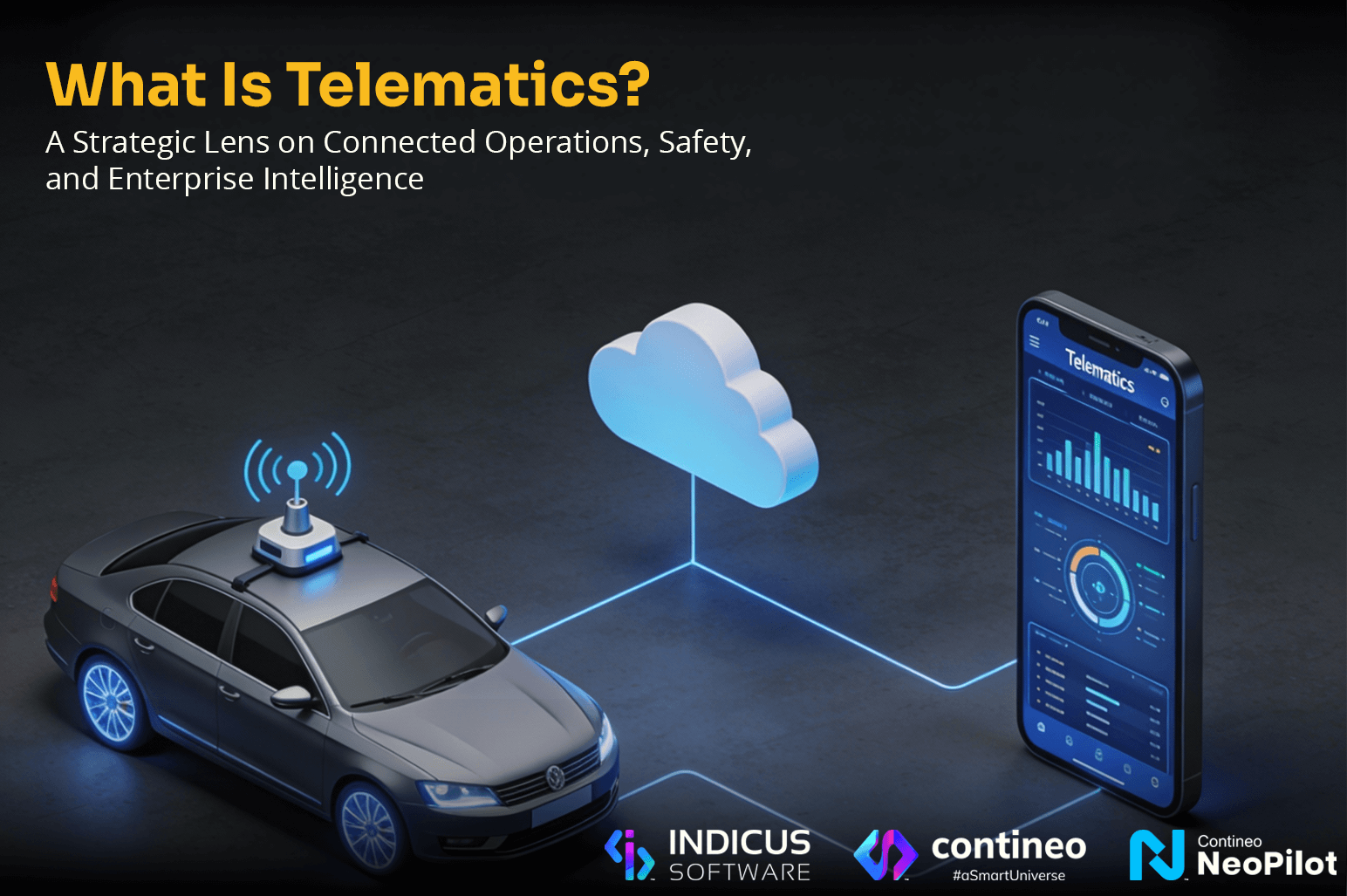
At its core, telematics refers to the convergence of telecommunications, data analytics, and embedded sensors to collect, transmit, and analyze information from moving or remote assets in real time.
Traditionally, telematics systems focused on basic location tracking and vehicle diagnostics. Modern telematics platforms now ingest hundreds of data points per asset, including speed, braking behavior, lane changes, collisions, video feeds, driver identity, equipment health, and environmental signals.
This data is processed through cloud based pipelines and translated into dashboards, alerts, workflows, and predictive insights that inform operational and strategic decisions.
For enterprise leaders, telematics is no longer a technology investment. It is a capability that directly influences safety performance, operating margins, customer experience, and regulatory compliance.
Why Telematics Has Become a Board-Level Priority
Several structural forces have pushed telematics into the executive agenda.
First, operational complexity has increased dramatically. Fleets and assets are distributed across cities, countries, and regulatory environments. Manual monitoring and periodic reporting no longer provide adequate visibility.
Second, safety expectations have risen. Regulators, insurers, and customers expect demonstrable proof of safe operations, not just policies on paper.
Third, cost pressures demand precision. Fuel inefficiencies, unplanned downtime, and reactive maintenance erode margins silently until they become material.
Finally, digital transformation initiatives increasingly require real world data. Telematics bridges the gap between physical operations and enterprise digital systems.
In this context, telematics becomes a strategic control layer rather than an operational add-on.
From Data Exhaust to Decision Intelligence
One of the most common failures in telematics adoption is data overload without insight. Organizations collect massive volumes of sensor data but struggle to translate it into action.
Modern telematics platforms address this challenge through three critical shifts.
The first is unified data ingestion. Instead of siloed vendor specific devices, leading platforms aggregate data from GPS, vehicle control units, cameras, sensors, mobile devices, and authentication systems into a single architecture.
The second is contextual analytics. Speed alone has little meaning. Speed combined with location, road type, driver identity, time of day, and historical behavior creates actionable insight. This is where AI driven behavior analytics and risk scoring become essential.
The third is workflow integration. Insights only matter if they trigger action. Advanced telematics platforms integrate alerts with approval flows, maintenance workflows, incident management systems, and compliance reporting.
This evolution transforms telematics from passive monitoring into an active operational nerve center.
Real-World Applications Across Industries
While telematics originated in fleet management, its impact now spans multiple sectors.
In connected mobility and fleet operations, telematics enables real-time driver behavior analytics, collision detection, emergency alerts, and remote firmware updates. Organizations have used these capabilities to reduce operating cost per vehicle by over forty percent while simultaneously improving safety compliance and response times.
In smart city initiatives, telematics underpins shared mobility services where citizens reserve vehicles, authenticate access digitally, and complete journeys without human intervention. These systems require secure identity verification, location intelligence, and asset health monitoring at scale.
What connects these use cases is not the device, but the platform that unifies data, analytics, workflows, and governance.
What a Next Generation Telematics Platform Looks Like
Leading enterprises are now adopting a different model.
Next-generation telematics platforms are built as multi-tenant SaaS architectures designed for scale, security, and configurability. They support billions of data events, thousands of concurrent users, and rapid deployment across regions.
They embed AI and video analytics for behavior detection, anomaly identification, and predictive maintenance. They enable over-the-air updates to devices without operational disruption. They allow business users to configure dashboards, alerts, and workflows without deep technical dependency.
Most importantly, they serve as a foundation for broader digital transformation. The same platform that supports telematics can extend into OEE monitoring, KPI analytics, predictive vibration analysis, energy efficiency, quality systems, and document digitization.
This convergence is what turns telematics into an enterprise intelligence layer rather than a point solution.
Why Platform Thinking Matters
From a leadership perspective, the strategic choice is not which telematics feature to buy. It is whether to invest in a platform that can evolve with the organization.
Platform-based approaches reduce total cost of ownership by consolidating multiple systems. They accelerate innovation by enabling rapid application development using low code and AI-driven workflows. They ensure governance, security, and compliance across use cases and geographies.
Organizations that adopt this model are able to start small with a focused telematics initiative and scale into a connected digital enterprise without re-architecture.
This start small and finish big approach is increasingly becoming the hallmark of digital leaders.
The Role of Contineo in Enterprise Telematics
Contineo has been designed specifically for organizations that view telematics as a strategic capability rather than a standalone tool.
Built as an IoT- and AI-enabled low-code platform, Contineo enables enterprises to ingest telematics data at scale, apply advanced analytics, and integrate insights directly into operational workflows.
What differentiates Contineo is not just data collection but the ability for teams to build and extend applications rapidly. From driving behavior analytics and fleet dashboards to predictive maintenance, quality systems, and smart city services, organizations can leverage a single platform across domains.
This unified architecture allows leadership teams to reduce complexity, improve visibility, and accelerate transformation without compromising on security or performance.
Contineo’s approach aligns with the demands of global enterprises operating in regulated, high-reliability environments, as highlighted in multiple large-scale implementations across mobility, manufacturing, and life sciences.
Telematics as a Strategic Advantage
As industries move toward autonomous systems, AI driven operations, and real time decision making, telematics will only grow in importance.
The organizations that succeed will be those that treat telematics as a strategic asset integrated into their digital core. Those that continue to deploy isolated tracking solutions will struggle to keep pace.
For CEOs, CXOs, and operations leaders, the opportunity is clear. Telematics is no longer about knowing where assets are. It is about knowing how the enterprise is performing, why risks emerge, and where to act next.
Ready to Explore What Enterprise-Grade Telematics Can Do for Your Organization?
If you are evaluating how to modernize fleet operations, connected mobility, or asset intelligence initiatives, the next step is not another tool. It is a platform that can grow with your ambition.
Connect with the Contineo team to explore how a unified telematics and digital operations platform can help you start small and scale confidently.