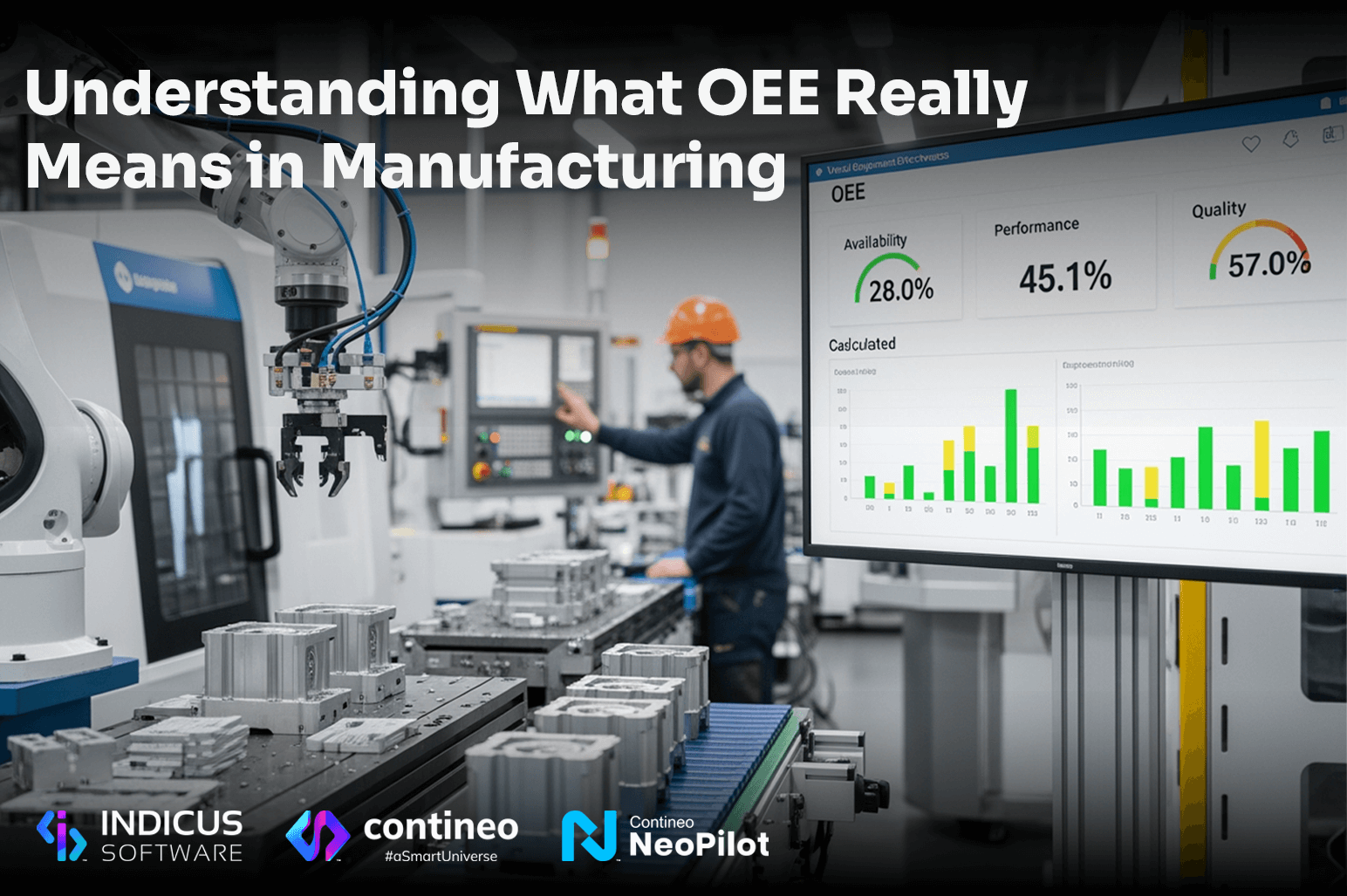
At its core, OEE measures how close a manufacturing operation is to achieving its maximum productive potential. It evaluates how effectively machines, lines, and production systems are used during planned production time. Rather than looking at isolated metrics such as output volume or machine uptime, OEE provides a unified view of productivity by capturing the combined impact of availability losses, performance inefficiencies, and quality issues.
This holistic perspective is what makes OEE so powerful. Many factories appear busy, with machines running and operators engaged, yet still lose a significant portion of their productive capacity due to short stoppages, speed losses, changeover delays, and quality rework. OEE brings these hidden losses into focus by quantifying how much planned time is truly productive. In doing so, it replaces assumptions with facts and creates a shared understanding of performance across teams.
In practical terms, OEE answers one of the most important questions in manufacturing: Are we getting the full value from the assets we already have?
Why OEE Has Become a Leadership-Level Metric
In the past, OEE was often confined to lean initiatives or continuous improvement programs. Today, its relevance has expanded far beyond the shop floor. As manufacturing operations become more complex and interconnected, leaders need a common performance language that aligns operational execution with business outcomes.
For executives, OEE provides a direct link between operational performance and financial results. It highlights whether production constraints are driven by equipment reliability, process inefficiencies, or quality variability, each of which requires a different strategic response. For plant and operations heads, OEE offers clarity on where to focus improvement efforts, which lines or assets are underperforming, and how performance varies by shift, product, or location. For supervisors and frontline teams, OEE creates transparency and accountability, enabling faster response to issues and more disciplined execution.
As manufacturers pursue digital transformation, OEE increasingly serves as the foundation upon which advanced analytics, automation, and AI-driven optimization are built.
How OEE Works in Real Manufacturing Environments
While the concept of OEE is simple, applying it effectively in real-world manufacturing environments is far more complex. Production lines experience frequent changeovers, varying product mixes, operator variability, maintenance interventions, and external disruptions. Manual data collection or spreadsheet-based OEE tracking struggles to capture this complexity accurately or in real time.
Modern OEE systems rely on continuous data streams from machines, sensors, PLCs, MES platforms, and operator inputs. This data is analyzed in real time to determine actual operating time, production speed relative to ideal conditions, and output quality. What matters most, however, is not just the OEE score itself, but the context behind it understanding which losses are occurring, when they occur, and why.
When OEE data is visualized through intuitive dashboards and tied to loss categorization, it becomes a decision-support tool rather than a reporting artifact. Teams can identify recurring issues, prioritize corrective actions, and track the impact of improvements with confidence. Over time, this shifts manufacturing organizations from reactive firefighting to proactive performance management.
The Business Value of OEE in Manufacturing
When implemented effectively, OEE delivers tangible business benefits across manufacturing operations. By identifying and addressing availability losses, organizations reduce unplanned downtime and improve asset utilization. By understanding performance losses, they optimize cycle times, balance lines, and increase throughput without additional capital expenditure. By minimizing quality losses, they reduce scrap, rework, and warranty costs while improving customer satisfaction.
Beyond these direct gains, OEE drives a deeper transformation in how organizations operate. It fosters a culture of continuous improvement, encourages cross-functional collaboration between production, maintenance, and quality teams, and creates a data-driven mindset at all levels of the organization. Manufacturers with mature OEE practices consistently outperform peers in delivery reliability, cost efficiency, and scalability.
Why Many OEE Initiatives Fall Short
Despite its potential, OEE initiatives often fail to deliver sustained impact. One common reason is that OEE is treated as a static KPI rather than a dynamic management system. Delayed reporting, manual data entry, and lack of contextual insights lead to low adoption and limited actionability.
Another challenge lies in fragmented data. Manufacturing data is frequently scattered across machines, lines, and systems, making it difficult to build a single source of truth. Traditional OEE tools may also lack flexibility, struggling to adapt to changing production conditions or scale across multiple plants.
These limitations prevent OEE from evolving into a strategic capability. Overcoming them requires a modern, integrated platform that connects data, workflows, and insights seamlessly this is where Contineo plays a critical role.
How Contineo Elevates OEE from Measurement to Manufacturing Intelligence
Contineo redefines OEE by embedding it within a broader manufacturing intelligence framework. Instead of treating OEE as a standalone metric, Contineo integrates real-time production data, maintenance events, quality outcomes, and operational context into a unified system.
Across manufacturing environments, Contineo’s OEE monitoring system provides real-time visibility into machine performance, downtime reasons, and efficiency trends. Its OEE dashboards go beyond percentages, highlighting loss drivers, performance patterns, and improvement opportunities in a way that is immediately actionable for supervisors and managers.
At the production-line level, Contineo’s OEE monitoring dashboards empower teams with live insights into line efficiency and bottlenecks, enabling rapid intervention and continuous improvement. At the plant and enterprise level, leaders gain a consolidated view of performance across lines and locations, supporting benchmarking, capacity planning, and strategic decision-making.
By leveraging low-code architecture, Contineo allows manufacturers to tailor OEE workflows to their specific processes, product mixes, and operational maturity without lengthy development cycles.
OEE as a Initiative for Digital Manufacturing Transformation
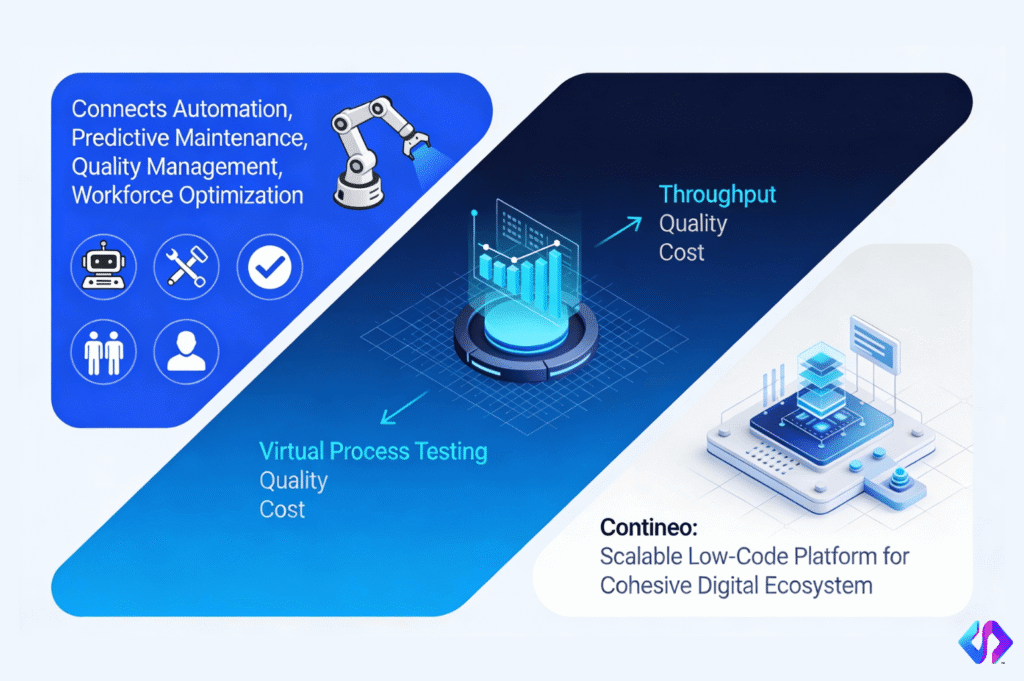
OEE plays a pivotal role in broader digital transformation initiatives. It acts as the performance backbone that connects automation, predictive maintenance, quality management, and workforce optimization. When combined with advanced analytics and AI, OEE data can be used to forecast capacity constraints, optimize production schedules, and simulate improvement scenarios before changes are implemented on the shop floor.
In advanced manufacturing environments, OEE is increasingly linked with digital twins, enabling manufacturers to test process changes virtually and understand their impact on throughput, quality, and cost. This capability reduces risk, accelerates improvement cycles, and enhances operational resilience.
Contineo enables this evolution by providing a scalable, low-code platform that integrates OEE with other manufacturing systems, creating a cohesive digital ecosystem rather than isolated tools.
Who OEE Is For and Why It Matters Now
OEE is relevant across the manufacturing hierarchy. For CXOs, it provides a clear view of how operational performance translates into financial outcomes. For plant heads and operations leaders, it becomes a daily management system that aligns teams around measurable goals. For supervisors and operators, it creates transparency, ownership, and clarity in execution.
As manufacturing competitiveness increasingly depends on speed, efficiency, and reliability, OEE is no longer optional. It is a foundational capability for organizations that want to scale sustainably, respond to market volatility, and maintain control over complex operations.
OEE Is About More Than Efficiency It’s About Operational Confidence
Overall Equipment Effectiveness has evolved into a strategic instrument for modern manufacturing. When implemented with the right digital platform, OEE provides more than performance metrics it delivers control, predictability, and confidence in operations.
With Contineo, manufacturers can move beyond basic OEE tracking to build an intelligent, real-time performance management system that drives continuous improvement across production lines and plants. By transforming OEE into actionable intelligence, Contineo helps manufacturing leaders unlock hidden capacity, improve execution, and build resilient, high-performing operations.
Ready to unlock hidden capacity and improve manufacturing performance with real-time OEE insights?
See how Contineo helps manufacturing leaders transform production data into actionable intelligence.