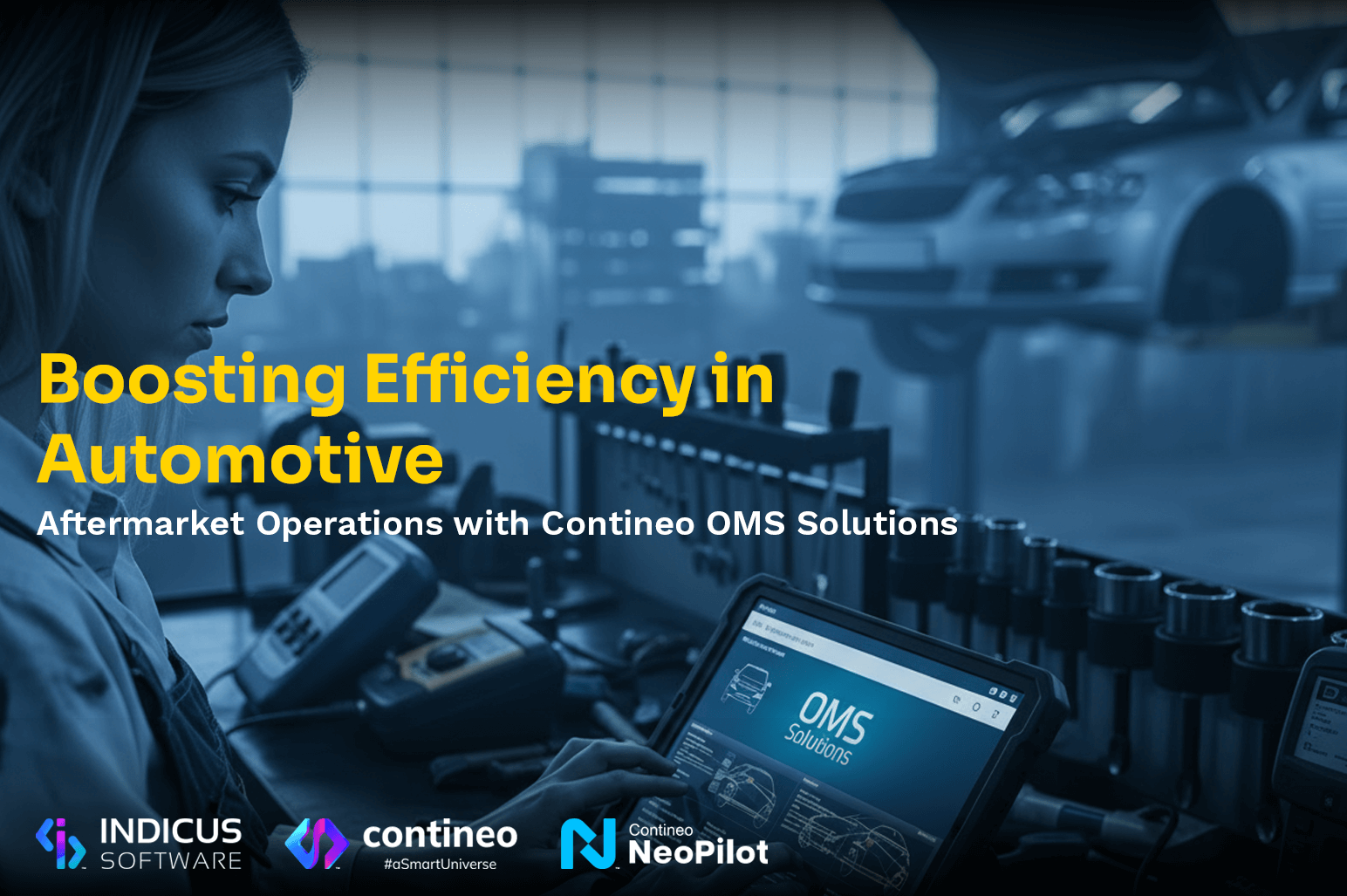
Aftermarket parts and service are high-margin, strategically vital revenue streams for OEMs and dealers. Yet many networks suffer avoidable cost and service losses because dealer ordering is fragmented, manual and disconnected from core ERP systems. A modern Aftermarket Order Management System (OMS) tightly integrated with ERP (SAP/S4) and augmented with AI and low-code deployment eliminates manual errors, compresses order cycle times, and materially improves parts availability and dealer experience. Contineo’s OMS is purpose-built for this problem set: it combines SAP-grade integration, AI-driven demand intelligence, LCNC speed of deployment and dealer-first UX to deliver measurable gains quickly.
1. The starting problem: why dealers still suffer inefficiency
Industry and customer research show the same recurring gaps in aftermarket ordering: fragmented ordering channels, manual PO entry and approval, absence of real-time parts availability/pricing, and weak ERP integration that produces duplicate entries and long reconciliation cycles. These gaps increase order errors, create long lead times, reduce first-time fill rates and produce frustrated dealers and lost revenue. The proposal we reference explicitly lists these as the primary pain points and sets real-time SAP integration as a core objective.
2. How a modern OMS reduces manual errors
2.1 Automated data capture and validation
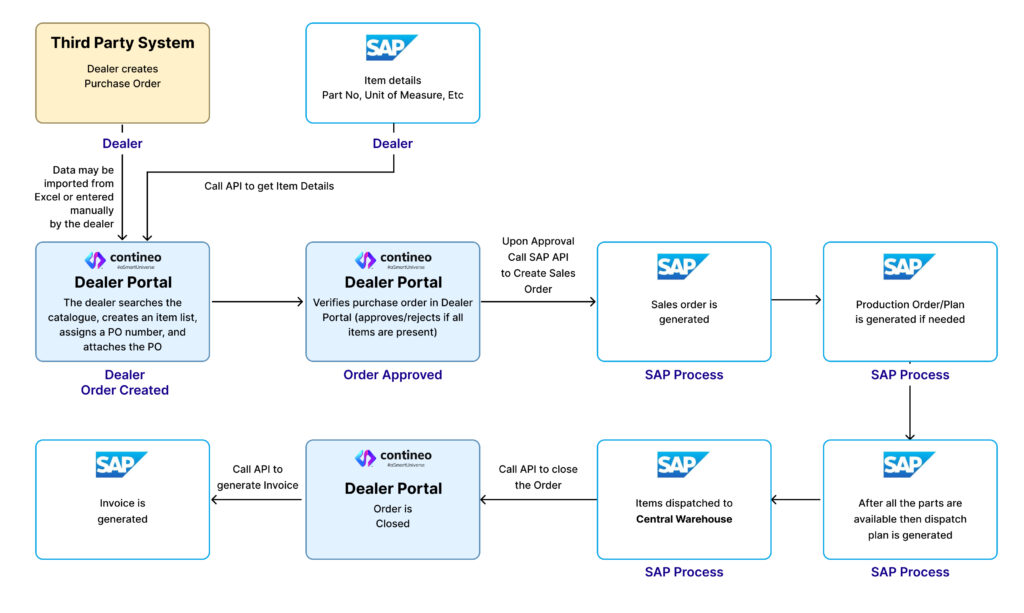
Instead of manual PO transcription, a dealer uploads or creates the PO through the portal; the OMS validates part numbers, pricing, eligibility and dealer credit automatically against the master data in SAP (materials master, pricing, contracts). Automated field validation and rule engines remove the most common human data-entry mistakes (wrong part number, incorrect pricing, mismatched dealer codes). Industry analyses show that eliminating manual touchpoints in order creation directly reduces processing errors and prevents late shipments.
2.2 Single source of truth via real-time ERP sync
When the OMS reads/writes directly to SAP (OData / S/4HANA order APIs), the system avoids duplicate entry and reconciliation workflows that are a major source of errors. Real-time inventory and pricing lookups ensure the dealer orders against the live catalogue rather than stale spreadsheets. This is the central design in the Contineo dealer portal architecture (real-time SAP sync, catalogue, inventory, approval/workflows).
2.3 Workflow enforcement and auditable approvals
Automatic approval workflows (credit checks, special price authorizations, stock allocation) standardize decision points and create an auditable trail reducing “manual bypass” and the downstream errors it causes. The flowchart explicitly maps PO → approval → SO → production order and highlights where LLM/AI can automate approval decisions where policy allows.
Net effect: Removal of manual transcription and standardized validations sharply reduce order accuracy exceptions and rework. Practical studies of order-automation in B2B contexts report meaningful reductions in manual touchpoints and error rates after OMS adoption.
3. How OMS speeds up order processing
3.1 Instant availability checks at point of order
When a dealer selects a part, the OMS performs a live inventory lookup (across DCs) and displays availability and ETA. This eliminates the “call to confirm” latency and prevents orders that must be cancelled or corrected later. The Contineo flow shows Parts Browsing → Price & Availability check → Real-time inventory update → Invoice generation → SAP sync.
3.2 Automation of approvals and invoicing
By automating routine approvals (credit, special pricing thresholds) and by generating invoices when the order is confirmed, the order-to-invoice cycle compresses from days to hours (or minutes for standard SKUs). Industry automation frameworks show that automated order processing noticeably reduces time-to-fulfilment and administrative overhead.
3.3 Direct ERP conversion (SO → Production order)
Where the manufacturer must convert sales orders into production/fulfilment orders, automated SO creation in SAP eliminates manual entry and reduces lead time for production scheduling. The OMS solution maps the SO→Production step and recommends automating it where policy permits.
Result: Typical order-handling latency (entry → validation → approval → fulfilment) is reduced substantially; dealers receive faster confirmations, accuracy increases, and warehouse and logistics planning become more predictable.
4. How OMS improves operational efficiency across the network
4.1 Better inventory economics (fewer rush shipments, higher turns)
When an OMS is combined with AI demand prediction, OEMs and dealers can reduce safety stock while maintaining service levels. Published vendor and case literature documents inventory reductions (often cited in the 20–35% range) while improving service levels when AI-driven planning replaces heuristics. For aftermarket planning specifically, AI has been shown to cut inventory and raise service level metrics materially.
4.2 Data-driven replenishment and promotions
An integrated OMS creates transaction trails and triggers: low-stock alerts, automated replenishment, dynamic special-price workflows and targeted marketing to dealers based on actual sell-through.
4.3 Visibility and KPI analytics
Dashboards that combine order pipelines, fill-rates, turn times, dealer NPS and parts profitability turn operational data into decisions. The Contineo/Indicus documents emphasize KPI analytics and customizable dashboards to enable non-IT users to monitor and act on these KPIs.
4.4 Fewer disputes, faster cash conversion
Reduced errors and automated invoicing reduce disputes and speed reconciliation; this shortens days-sales-outstanding from both dealer and OEM perspectives and reduces manual AR work. Industry sources on order automation corroborate these financial benefits.
5. Why Contineo OMS is superior to typical aftermarket OMS
Below are the concrete differentiators where Contineo delivers a sustained advantage for OEMs and dealer networks:
- Native SAP/S/4HANA integration architecture (OData / real-time sync): Contineo’s dealer portal design explicitly maps to SAP Materials, SD, MM and Finance modules to avoid duplicate entry and preserve master data integrity.
- LCNC platform for rapid deployment and adaptation: Contineo is built on an LCNC stack that enables rapid, modular rollout (portal + mobile app) and faster iteration for approvals, catalog updates and workflows. Low-code deployment materially reduces integration project time and cost versus heavy bespoke builds. Industry research shows LCNC reduces time-to-market and simplifies ERP extensions.
- Agent AI and NeoPilot orchestrator: Contineo includes an agent AI layer (NeoPilot) that can: surface demand forecasts, recommend allocations, and where allowable automate approvals (for example using LLMs to classify and approve standard POs). This makes decisions faster and enforces policy consistently. The flowchart even calls out LLM-based approval automation as a viable step depending on IT policy.
- Dealer-first UX (web + mobile) and pre-built use cases: Contineo’s portal and mobile web app are designed for dealer workflows: catalogue browse, live prices, order status and invoicing on the same interface. That reduces training and increases adoption vs. legacy portals. The solution brief lists live catalogue, availability, order status and automated invoicing as built-in capabilities.
- Pre-tested in demanding environments: The Contineo LCNC and agent technology have been deployed in large, security-sensitive enterprises, giving confidence for complex OEM ecosystems and regulatory compliance.
- End-to-end telemetry & KPI analytics: Contineo packages dashboards, alerts and analytics so both dealers and OEM planners get the same actionable dataset, avoiding finger-pointing and accelerating corrective action.
Many aftermarket OMS products focus only on order routing or on one layer (warehouse, or dealer portal). Contineo combines deep ERP integration + LCNC speed + embedded AI orchestration + dealer UX to both reduce transactional friction and improve strategic aftermarket performance (stock optimisation and revenue uplift).
A modern Aftermarket OMS is not merely a portal, it is the nucleus of a dealer-OEM aftermarket ecosystem. By removing manual touchpoints, enabling real-time ERP synchronization, and applying AI for forecasting and orchestration, OEMs dramatically reduce errors, accelerate processing and unlock aftermarket margin. Contineo combines SAP-grade integration, an LCNC platform for rapid deployment and an agent AI layer to deliver both operational improvements and strategic aftermarket gains faster and with lower project risk than traditional, heavy-custom alternatives.
To learn more please Request a Demo with our digital transformation experts today!