Turning Service Complexity Into Strategic Advantage
India’s elevator market is expanding across residential towers, commercial hubs, hospitals, transit infrastructure, and smart cities. Installation growth is visible. What is less visible, but far more decisive, is the transformation underway in service operations.
For CEOs, COOs, Service Heads, and Managing Directors, maintenance is no longer an operational function. It is a competitive battleground. Lifetime service revenue often exceeds installation revenue. Customer retention depends on uptime. Brand equity depends on responsiveness.
Yet a large part of the industry continues to operate in reactive or calendar driven preventive models. Breakdowns occur first. Action follows later.
Predictive maintenance changes that equation.
Why Reactive Maintenance Fails in Indian Conditions
Reactive models struggle particularly in India due to environmental and operational realities that are often underestimated.
Consider three real world edge scenarios:
Monsoon Humidity Impact
In coastal cities like Mumbai and Chennai, prolonged monsoon humidity affects door sensors and control boards. Moisture buildup can cause intermittent door faults long before complete failure. A reactive system only responds when the elevator stops functioning. A predictive system detects abnormal sensor readings and increasing resistance patterns before breakdown.
Voltage Fluctuations in Tier 2 Cities
In cities with unstable power supply, voltage fluctuations stress drive systems and control panels. Without real time monitoring of voltage patterns and motor performance, failures appear sudden. In reality, degradation signals were available weeks earlier.
High Traffic Commercial Towers
An elevator operating in a 30 floor IT park experiences exponentially higher door cycles compared to a residential building. Time based preventive schedules treat both similarly. Predictive analytics differentiate based on usage intensity and component wear patterns.
These scenarios illustrate a broader truth. Elevators do not fail randomly. They deteriorate in patterns. The ability to detect those patterns defines service maturity.
What Predictive Maintenance Actually Requires
Predictive maintenance is not just about installing sensors. It requires a structured data to action pipeline.
At a high level, the flow works as follows:
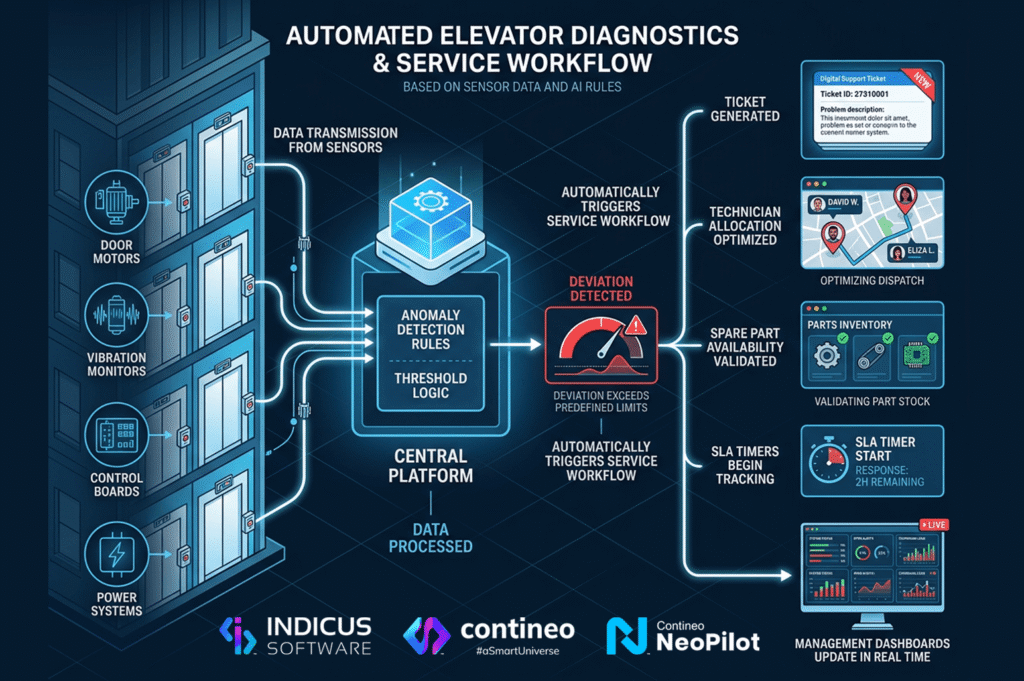
Sensor data from door motors, vibration monitors, control boards, and power systems is transmitted to a central platform. Data is processed using anomaly detection rules and threshold logic. When deviation exceeds predefined limits, the system automatically triggers a service workflow. A ticket is generated. Technician allocation is optimized. Spare part availability is validated. SLA timers begin tracking. Management dashboards update in real time.
Without automated workflow orchestration, this pipeline breaks at the decision stage. Data may exist, but action remains manual.
The Real Gap: Orchestration Across Legacy Systems
Most elevator manufacturers operate with a mix of legacy hardware and modern digital tools. Installed bases often include elevators deployed over decades, running on heterogeneous control systems. Replacing all hardware to enable predictive capability is neither practical nor economically viable.
This is where low code platforms must be understood correctly.
Low code does not replace legacy hardware. It integrates and orchestrates it.
A robust low code digital backbone connects to existing PLC systems, IoT gateways, ERP platforms, and service applications through APIs, middleware, or edge connectors. It creates a workflow layer above legacy infrastructure.
For example:
An older elevator without advanced native analytics can still transmit basic operational signals through retrofit IoT modules. The low code platform ingests that data, applies rule based triggers, and integrates directly with service ticket systems and inventory databases. No wholesale hardware replacement is required.
Low code becomes the bridge between past investments and future intelligence.
Legacy Coordination Versus Workflow Automation
In a legacy setup, predictive alerts may generate emails. Supervisors manually review them. Tickets are created later. Spare parts are checked through phone calls. Technician schedules are adjusted informally. Escalations occur only after SLA risk becomes visible.
In aworkflow automated environment, anomaly detection directly triggers structured service flows. Approvals are rule driven. Inventory checks are system validated. Technicians receive tasks through mobile apps. Escalations are automatic when thresholds are breached.
The difference is not cosmetic. It is structural.
Legacy coordination depends on human vigilance. Workflow automation institutionalizes discipline.
Why Sensors Alone Are Not Enough
Many organizations deploy IoT devices but fail to achieve measurable ROI. The root cause is fragmentation. Data is captured but not fully integrated with business workflows.
Predictive maintenance becomes transformative only when:
- Anomalies automatically generate structured tickets
- Technician allocation is algorithm driven
- Spare part inventory is dynamically linked
- Compliance logs update in real time
- Leadership dashboards provide portfolio level visibility
This orchestration layer is where Contineo delivers enterprise value.
Contineo as the Digital Backbone
Contineo enables elevator manufacturers to design predictive maintenance ecosystems without disrupting legacy infrastructure. Through configurable workflows, API-based integrations, and modular application design, organizations can connect IoT data streams to service execution, inventory management, SLA tracking, and compliance governance within a unified architecture.
Rather than replacing existing systems, Contineo sits above them as an intelligent orchestration layer. It ensures that data triggers disciplined action.
For leadership teams, this means:
- Scalable predictive service models
- Reduced operational variability
- Faster order to resolution cycles
- Improved technician utilization
- Audit ready compliance visibility
In a market where global players such as KONE, Otis Worldwide Corporation, ThyssenKrupp Group and Schindler Group are strengthening digital capabilities, Indian manufacturers must accelerate their transformation journey.
From Reactive Firefighting to Predictive Governance
The future of elevator maintenance in India will not be defined by how quickly teams respond to breakdowns. It will be defined by how effectively organizations prevent them.
Environmental stress, infrastructure variability, and growing urban density make predictive capability indispensable. However, sustainable advantage requires more than IoT deployment. It requires workflow automation built on a flexible, integration ready digital backbone.
Low code platforms such as Contineo make this transition economically viable, even for enterprises operating mixed legacy fleets.
For CXOs evaluating the next phase of digital transformation, the opportunity is clear. Each predictive ticket avoided saves cost. Each hour of downtime prevented strengthens customer trust. Each automated workflow reduces operational friction.
The shift from reactive to predictive is no longer optional. It is the foundation for service led leadership in India’s vertical mobility ecosystem.
If your organization is ready to convert data into disciplined execution and measurable ROI, this is the moment to initiate that transformation.
Request a demo with our experts today and discover how Contineo can transform your service operations.