Software development is undergoing its biggest transformation since the invention of high-level programming languages. Imagine telling an AI system “I need a customer management app with invoicing and reporting” and watching a fully functional business application come to life in under an hour. This isn’t science fiction – it’s happening right now through conversational software development.
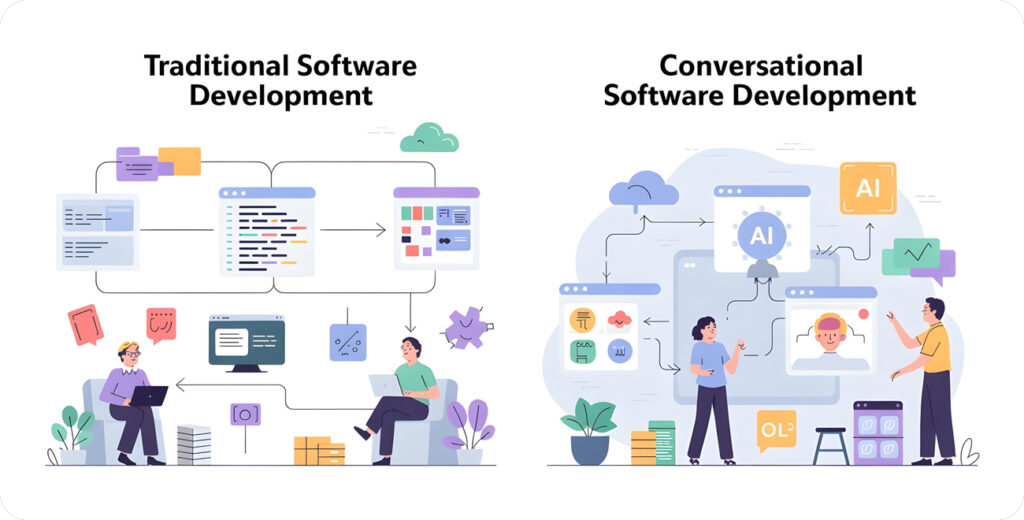
The traditional software development process – requirements gathering, design, coding, testing, deployment – often takes months and requires specialized technical teams. Today’s conversational AI platforms are reducing these timelines from months to minutes, while enabling non-technical users to build sophisticated applications through simple conversations.
From Code to Conversation
The shift from traditional programming to conversational development represents a fundamental change in how humans interact with computers. Instead of learning complex programming languages, users now describe what they want in natural language, and AI systems translate these descriptions into working applications.
Modern platforms like NeoPilot which are powered by GenAI and Agentic AI, demonstrate this transformation in action. Built on advanced AI orchestration, NeoPilot acts as an intelligent software engineer that understands business requirements through natural conversation. When a user describes their needs – whether it’s inventory management, customer tracking, or workflow automation – the system asks intelligent follow-up questions to uncover requirements the user might not have considered and also suggests some add-on features which will help the application scale-up in future.
This isn’t just autocomplete for code. These AI systems understand business processes, data relationships, and user experience principles. They can automatically generate database schemas, create user interfaces, build workflows, and integrate different systems – all through conversational interaction. The AI becomes a collaborative partner that brings both technical expertise and business analysis capabilities to every project.
Recent breakthroughs in large language models including Reasoning in AI, have made this possible. AI systems now understand context across entire projects, maintain consistency in architectural decisions, and can work autonomously for hours on complex development tasks. They’re not just writing code – they’re architecting complete solutions.
When Everyone Becomes a Creator
Perhaps the most revolutionary aspect of conversational development is how it’s democratizing software creation. Business users who previously depended on IT departments can now build their own solutions. A restaurant owner can create a point-of-sale system, a small manufacturer can build inventory tracking, or a nonprofit can develop donor management tools – all without writing a single line of code.
This democratization is driven by the intuitive nature of conversation. Users explain their problems in their own words, using domain-specific terminology they already understand. The AI system handles the technical translation, asking clarifying questions and suggesting features based on industry best practices.
NeoPilot excels at this requirements elaboration process. Instead of overwhelming users with technical options, it guides them through thoughtful conversations that uncover the full scope of what’s needed. The system asks: “Do you need multi-location inventory tracking?” or “Should suppliers receive automated purchase orders?” – questions that help build comprehensive solutions rather than basic tools.
The impact extends beyond individual productivity. Organizations report that citizen developers – business users who build applications – now create the majority of new business software. This shift isn’t about replacing professional developers but about freeing them from routine tasks to focus on complex, strategic projects.
Real-World Applications Across Industries
Conversational development is transforming operations across every industry. In manufacturing, plant managers build real-time production monitoring systems that track equipment performance and predict maintenance needs. Healthcare providers create patient management platforms that coordinate care across multiple locations. Retailers develop inventory optimization tools that automatically adjust stock levels based on demand patterns.
The versatility comes from the AI’s ability to understand different business domains. The same conversational platform that helps a logistics company optimize delivery routes can assist a school district in managing student transportation. The underlying technology adapts to each industry’s specific requirements and terminology.
Success stories are emerging across sectors. Manufacturing companies report reducing development time by 90% while achieving better integration with existing systems. Healthcare organizations build custom applications for compliance tracking and patient communication in weeks rather than months. Educational institutions create learning management tools tailored to their specific curriculum and student needs.
These aren’t simple database applications. Modern conversational platforms generate sophisticated business applications with features like automated workflows, real-time analytics, mobile interfaces, and integration with existing enterprise systems. NeoPilot, for example, can create complete business process management (BPM) flows, generate interactive dashboards, and establish data models with complex relationships – all through conversational interaction.

Speed, Cost, and Quality
The business impact of conversational development extends far beyond faster delivery times. Organizations report dramatic cost reductions compared to traditional development approaches. Instead of hiring expensive development teams or waiting months for IT resources, business users can create solutions immediately using existing staff.
Development speed improvements are particularly striking. Projects that previously required six-month timelines now complete in days or weeks. This acceleration isn’t just about coding faster – it’s about eliminating the communication gaps between business users and technical teams. When the person who understands the problem can directly create the solution, requirements don’t get lost in translation.
Quality improvements often exceed expectations. AI-generated applications follow consistent architectural patterns, include proper error handling, and avoid common security vulnerabilities. The systems automatically implement best practices that might be overlooked in rushed manual development projects.
The iterative nature of conversational development also enables continuous improvement. Users can easily modify applications by describing desired changes, making it simple to adapt solutions as business needs evolve. This flexibility proves especially valuable in rapidly changing market conditions.
Overcoming Challenges and Limitations
Despite its transformative potential, conversational development faces real challenges. Security and governance concerns top the list for enterprise organizations. When non-technical users can create applications, ensuring proper data handling and access controls becomes crucial.
Integration with existing enterprise systems presents another hurdle. While modern platforms can connect with many business applications, complex legacy systems may require specialized expertise. Organizations must balance the speed of conversational development with the need for robust system architecture.
Quality assurance also requires new approaches. Traditional code review processes don’t apply when AI generates applications through conversation. Organizations need new frameworks for testing and validating conversationally-built applications.
However, leading platforms address many of these concerns through built-in safeguards. They include automated security scanning, compliance checking, and integration validation. Professional developers increasingly work alongside citizen developers, providing architectural guidance while business users handle application creation.
What’s Coming Next
The trajectory of conversational development points toward even more sophisticated capabilities. Future systems will understand context across multiple applications, suggest optimizations based on usage patterns, and automatically evolve solutions as business requirements change.
Integration with emerging technologies promises additional possibilities. Voice interfaces could enable hands-free application development, while augmented reality might allow users to design interfaces by manipulating virtual objects. The core principle remains consistent: reducing the barrier between human intent and digital implementation.
Market growth projections reflect this potential. The combined conversational AI and low-code development markets are expected to reach significant scale within the next decade, driven by organizational demands for faster, more accessible software development.
For businesses, the strategic implications are clear. Organizations that embrace conversational development gain competitive advantages through faster innovation cycles, reduced dependence on scarce technical resources, and better alignment between business needs and software solutions.
We at Indicus Software are leveraging the cutting edge technologies to build products that not just serve a purpose but bring an impact to the society.
Sign up for NeoPilot to be at the forefront of the technology!