Manufacturing equipment failures cost companies millions in lost production, emergency repairs, and missed deadlines. Predictive Maintenance In Manufacturing using AI offers a game-changing solution that spots potential problems weeks or months before they cause expensive breakdowns.
This paper is intended for business leaders, manufacturing managers, and plant operations teams, who want to move beyond reactive maintenance and start preventing equipment failures before they happen.
We’ll explore how traditional maintenance approaches drain your budget and disrupt production schedules, then show you how AI-powered systems can predict equipment issues with remarkable accuracy. You’ll also discover the key technologies that make predictive maintenance possible and see real implementation strategies that manufacturing companies use to slash downtime and boost their bottom line.
Understanding Traditional Maintenance Approaches and Their Costly Limitations
Reactive Maintenance Drains Budgets Through Emergency Repairs
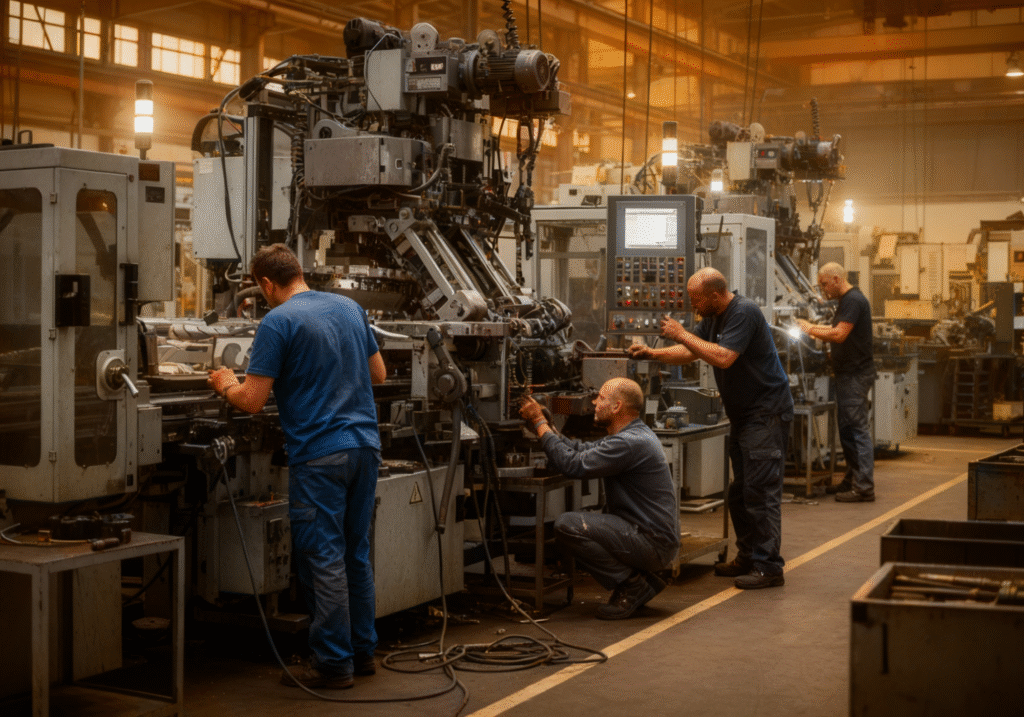
When equipment breaks down unexpectedly, manufacturing facilities enter crisis mode. Emergency repairs demand immediate attention, pulling maintenance teams away from planned activities and forcing them into costly overtime scenarios. The “fix-it-when-it-breaks” approach might seem economical on the surface, but the numbers tell a different story.
Emergency repair costs typically run 3-5 times higher than planned maintenance activities. Rush orders for replacement parts come with premium pricing, expedited shipping fees, and limited supplier options. Maintenance crews working under pressure often need specialized contractors or overtime labor, driving costs even higher. A single catastrophic failure can consume an entire quarter’s maintenance budget in just a few days.
Indicus’ Contineo platform eliminates this uncertainty through AI-driven predictive insights. Its Tri-axial vibration analytics and EdgeCross integration detect abnormal patterns long before breakdowns occur, enabling teams to plan interventions without disrupting production.
Scheduled Maintenance Wastes Resources on Unnecessary Interventions
Time-based maintenance schedules operate on rigid intervals regardless of actual equipment condition. This approach leads to replacing perfectly functional components simply because the calendar says it’s time. Manufacturing facilities routinely change filters, belts, and fluids that could operate effectively for weeks or months longer.
Calendar-driven maintenance also creates artificial peaks and valleys in workload distribution. Maintenance teams face overwhelming schedules during predetermined service windows, followed by periods of reduced activity. This inefficient resource utilization increases labor costs and reduces overall productivity.
With Indicus’ Asset Maintenance module, factories shift from rigid schedules to condition-based maintenance. Connected sensors and AI/ML models within Contineo’s Industrial DX Platform continuously analyze equipment performance, triggering maintenance only when truly needed reducing waste and extending asset life.
Equipment Failures Disrupt Production Schedules and Customer Deliveries
Unplanned downtime creates a domino effect that extends far beyond the failed equipment. Production lines grind to a halt, forcing workers into idle time while emergency repairs take place. Manufacturing facilities operating on lean principles have minimal buffer capacity, making every minute of downtime critically expensive.
Customer commitments become impossible to meet when key equipment fails unexpectedly. Late deliveries damage relationships, trigger penalty clauses, and jeopardize future contracts. Sales teams scramble to manage customer expectations while operations teams work frantically to restore production capability.
Contineo’s OEE & Breakdown Analysis gives manufacturing leaders real-time visibility into line performance, downtime causes, and recovery trends. Integrated alerts from the platform ensure that potential failures are addressed proactively protecting delivery schedules and customer trust.
Hidden Costs of Downtime Extend Beyond Repair Expenses
The true cost of equipment failure includes numerous hidden expenses that rarely appear on maintenance reports. Lost production represents the most significant hidden cost, with some manufacturing operations losing thousands of dollars per minute during critical equipment downtime.
Quality issues frequently emerge during the restart process as equipment may not immediately return to optimal operating parameters. Product waste, rework costs, and potential customer returns add substantial expense to the initial failure event. Safety risks also increase when maintenance teams work under pressure to restore production quickly.
By integrating KPI Analytics Dashboards and digital maintenance workflows, Indicus’ predictive maintenance ecosystem ensures problems are addressed before they escalate. Plants experience lower energy waste, safer repair environments, and a steady increase in operational efficiency.
How AI-Powered Predictive Maintenance Transforms Equipment Management
Machine Learning Algorithms Detect Patterns in Equipment Behavior
Modern manufacturing equipment generates massive amounts of operational data every second, creating patterns that reveal the true health of machinery. Machine learning algorithms excel at processing this complex information, identifying subtle correlations between vibration signatures, temperature fluctuations, pressure variations, and eventual equipment failures.
These algorithms learn from historical maintenance records, equipment specifications, and operational conditions to build comprehensive baseline models of normal equipment behavior. When deviations occur, the system immediately flags them as potential indicators of developing issues. The algorithms become increasingly sophisticated over time, refining their detection capabilities based on new data and maintenance outcomes.
Different types of machine learning models serve specific purposes in equipment monitoring. Classification algorithms identify whether equipment operates within normal parameters, while regression models predict remaining useful life. Clustering techniques group similar failure patterns, helping maintenance teams understand common failure modes across their equipment fleet.
Real-Time Sensor Data Enables Continuous Monitoring Capabilities
Industrial IoT sensors have revolutionized equipment monitoring by providing continuous streams of real- time data from critical machinery components. These sensors measure vibration levels, temperature changes, pressure readings, acoustic emissions, and electrical signatures around the clock, creating a comprehensive picture of equipment health.
The continuous monitoring approach represents a dramatic shift from traditional time-based inspections. Instead of checking equipment monthly or quarterly, sensors capture thousands of data points every minute, detecting gradual degradation patterns that would otherwise remain invisible until catastrophic failure occurs.
Modern sensor networks integrate seamlessly with existing manufacturing systems, transmitting data wirelessly to central monitoring platforms. Edge computing capabilities allow immediate processing of sensor data at the machine level, reducing network bandwidth requirements while enabling instant response to critical alerts.
Predictive Models Forecast Failure Probability with Remarkable Accuracy
Advanced predictive models combine historical failure data with real-time sensor readings to calculate precise failure probabilities for individual equipment components. These models account for multiple variables including operating conditions, maintenance history, environmental factors, and current performance metrics.
The accuracy of these predictions has reached impressive levels, with some systems achieving 85-95% accuracy in forecasting equipment failures weeks or months in advance. This precision allows maintenance teams to schedule interventions during planned downtime windows, avoiding costly emergency repairs and production interruptions.
Predictive models adapt continuously as they process new data, becoming more accurate over time. They account for seasonal variations, production schedule changes, and equipment aging patterns, providing increasingly reliable failure forecasts that maintenance teams can confidently act upon.
Automated Alerts Trigger Maintenance Actions at Optimal Timing
Smart alert systems analyze predictive model outputs and automatically notify maintenance personnel when intervention becomes necessary. These systems prioritize alerts based on severity, potential impact on production, and available maintenance resources, ensuring critical issues receive immediate attention.
The automation extends beyond simple notifications. Advanced systems can automatically generate work orders, schedule maintenance appointments, and even order replacement parts based on predicted failure timelines. This proactive approach eliminates delays between failure detection and maintenance response.
Customizable alert thresholds allow maintenance managers to fine-tune notification settings for different equipment types and operational priorities. The system learns from maintenance team responses, adjusting alert sensitivity to minimize false alarms while ensuring no critical issues go unnoticed.
Essential Technologies Driving Predictive Maintenance Success
Internet of Things sensors collect comprehensive equipment data
IoT sensors form the backbone of any successful predictive maintenance program. These tiny devices attach to motors, pumps, bearings, and other critical machinery components to monitor dozens of performance parameters in real-time. Temperature sensors track heat buildup that signals bearing wear, while vibration sensors detect the subtle changes in machinery rhythm that precede catastrophic failures.
Modern industrial IoT sensors capture everything from acoustic emissions and electrical current draw to oil viscosity and pressure fluctuations. Wireless connectivity allows these sensors to transmit data continuously without disrupting production workflows. Battery-powered sensors can operate for years in harsh manufacturing environments, withstanding extreme temperatures, chemical exposure, and electromagnetic interference.
The real power comes from sensor fusion – combining multiple sensor types to create a complete picture of equipment health. A single motor might have temperature, vibration, current, and acoustic sensors working together to identify patterns invisible to any single measurement. This comprehensive data collection enables maintenance teams to spot problems weeks or months before traditional inspection methods would detect them.
Advanced analytics platforms process massive data streams efficiently
Processing the flood of sensor data requires sophisticated analytics platforms designed specifically for industrial applications. These systems handle millions of data points daily, applying machine learning algorithms to identify normal operating patterns and flag deviations that signal potential problems.
Edge computing capabilities allow critical analysis to happen locally on the factory floor, reducing network latency and ensuring immediate alerts for dangerous conditions. Cloud-based platforms provide the computational power needed for complex modeling and historical trend analysis across entire manufacturing networks.
Machine learning models continuously improve their accuracy by learning from past failures and maintenance outcomes. Natural language processing helps maintenance teams understand complex alerts, while automated reporting keeps management informed about equipment performance trends. Integration with existing enterprise systems ensures predictive insights flow seamlessly into work order management and inventory planning processes.
Digital twin technology creates virtual equipment replicas for testing
Digital twins represent the cutting edge of predictive maintenance technology. These virtual replicas mirror physical equipment behavior in real-time, allowing maintenance teams to test scenarios and predict outcomes without touching actual machinery.
Sophisticated physics-based models simulate how equipment responds to different operating conditions, wear patterns, and maintenance interventions. Teams can virtually test the impact of delaying repairs, compare different maintenance strategies, or predict how equipment modifications will affect performance. This capability transforms maintenance from reactive guesswork into precise, data-driven decision making.
Digital twins integrate historical maintenance records, current sensor data, and environmental factors to create incredibly accurate predictions. They can simulate years of operation in minutes, helping teams optimize maintenance schedules and identify the most cost-effective repair strategies before committing resources.
Proven Business Benefits That Justify Predictive Maintenance Investment
Reduced unplanned downtime increases production efficiency significantly
Manufacturing facilities lose an average of $50,000 per hour during unplanned equipment downtime, making predictive maintenance a game-changer for operational efficiency. By identifying potential failures weeks or months in advance, manufacturers can schedule maintenance during planned shutdowns rather than scrambling to fix emergency breakdowns.
The data speaks volumes: companies implementing AI-driven predictive maintenance report 30-50% reduction in unplanned downtime. This translates directly to increased production capacity without additional capital investment. When machines run reliably according to schedule, production teams can meet delivery commitments, maintain customer relationships, and capture market opportunities that competitors miss due to equipment failures.
Smart sensors continuously monitor vibration patterns, temperature fluctuations, and performance metrics that signal impending problems. Machine learning algorithms analyze this data to predict exactly when components will fail, allowing maintenance teams to replace parts during scheduled maintenance windows. This proactive approach eliminates the cascade effect where one machine failure triggers delays across the entire production line.
Lower maintenance costs through optimized resource allocation
Traditional reactive maintenance often resembles expensive emergency surgery rushed technician callouts, overnight parts shipping, and premium contractor rates that can triple normal maintenance expenses. Predictive maintenance transforms this chaotic approach into strategic resource planning.
Maintenance teams can now order spare parts well in advance, securing better pricing through bulk purchases and avoiding rush delivery fees. Technicians can schedule work efficiently, eliminating overtime premiums and reducing the need for expensive external contractors. The precision of predictive analytics means organizations only perform maintenance when actually needed, avoiding unnecessary part replacements and reducing inventory carrying costs.
| Cost Reduction Area | Typical Savings |
| Emergency repairs | 60-70% |
| Spare parts inventory | 20-30% |
| Maintenance labor | 25-35% |
| Contractor services | 40-50% |
The ripple effects extend beyond direct maintenance costs. Optimized maintenance scheduling allows facilities to operate with leaner maintenance crews while achieving better equipment reliability. This staffing efficiency frees up budget for other strategic investments or drops directly to the bottom line.
Extended equipment lifespan maximizes capital investment returns
Manufacturing equipment represents enormous capital investments, often running into millions of dollars per machine. Predictive maintenance acts like a personal health monitor for this expensive machinery, ensuring optimal operating conditions that significantly extend useful life.
Equipment running under predictive maintenance protocols typically lasts 20-40% longer than machinery maintained through traditional methods. This extended lifespan defers major capital expenditures, improving cash flow and return on asset calculations. For a $2 million piece of equipment with an expected 15-year life, extending operation by just three years saves approximately $400,000 in replacement costs.
The key lies in catching problems while they’re still minor. A bearing showing early wear patterns can be replaced for hundreds of dollars during scheduled maintenance. Left unaddressed, that same bearing failure could damage connected components, turning a simple repair into a complete system rebuild costing tens of thousands of dollars.
Improved product quality through consistent equipment performance
Equipment operating at peak performance produces consistent, high-quality output. Predictive maintenance ensures machines maintain tight tolerances and optimal operating parameters, directly impacting product quality and reducing waste.
When equipment begins degrading, even subtle performance variations can affect product specifications. A cutting tool wearing beyond optimal sharpness creates rough edges. A conveyor system running slightly off-speed affects packaging integrity. These quality issues often appear before complete equipment failure, but traditional maintenance approaches miss these early warning signs.
Predictive systems catch these performance deviations immediately, triggering maintenance interventions before quality suffers. Manufacturing facilities report 15-25% reduction in scrap rates and rework after implementing predictive maintenance programs. The cost savings from reduced waste often pays for the predictive maintenance system within the first year.
Enhanced worker safety by preventing catastrophic equipment failures
Catastrophic equipment failures pose serious safety risks to manufacturing workers. Explosions, flying debris, toxic leaks, and structural collapses can cause injuries, fatalities, and environmental damage that devastate companies financially and ethically.
Predictive maintenance systems monitor critical safety parameters continuously, providing early warnings about potentially dangerous conditions. Pressure vessels, rotating machinery, and electrical systems all generate predictable failure signatures before dangerous events occur. This advance warning allows maintenance teams to address problems safely during scheduled downtime rather than during emergency conditions.
The safety benefits extend beyond preventing major accidents. Predictive maintenance reduces the need for emergency repairs, which often occur under time pressure with inadequate safety precautions. Maintenance technicians working on scheduled repairs can follow proper lockout/tagout procedures, use appropriate safety equipment, and work without the stress and shortcuts that emergency situations create.
Workers also report higher job satisfaction and confidence when equipment operates reliably. The psychological stress of working with unreliable machinery affects productivity and workplace morale. Predictive maintenance creates a more stable, safer work environment where employees can focus on productive tasks rather than constantly worrying about equipment failures.
Real-World Implementation Strategies for Manufacturing Success
Start with critical equipment that impacts production most severely
Your predictive maintenance journey should begin where equipment failures hurt the most. Focus on machinery that creates production bottlenecks, generates safety hazards, or carries high replacement costs. Think about your main production line motors, conveyor systems, heavy-duty pumps, and precision cutting tools. These are typically your money-makers and your biggest risk factors.
Create a simple scoring system that weighs three factors: downtime cost per hour, repair complexity, and safety impact. Equipment earning the highest scores becomes your pilot program. This approach delivers quick wins that justify the technology investment to skeptical stakeholders.
Don’t try to monitor everything at once. Manufacturing facilities often make this mistake, spreading resources too thin and diluting results. Instead, master predictive maintenance on 3-5 critical assets before expanding. This focused approach allows your team to learn the technology, refine processes, and build confidence in the system.
Establish data collection infrastructure and sensor deployment plans
Building your data foundation requires strategic sensor placement and robust connectivity. Start by mapping the data points that matter most for each piece of equipment. Vibration sensors catch bearing wear and misalignment issues. Temperature sensors detect overheating in motors and hydraulic systems. Current sensors reveal electrical problems before they become catastrophic failures.
Your sensor network needs reliable data transmission to your analytics platform. Industrial ethernet, wireless protocols like LoRaWAN, or cellular connections all work depending on your facility layout and requirements. Plan for redundancy in critical areas because missing data during a potential failure event defeats the purpose.
Consider your existing systems when planning the infrastructure. Many modern PLCs and SCADA systems can integrate with predictive maintenance platforms, saving installation costs. However, legacy equipment might need retrofit solutions or edge computing devices to bridge the gap between old machinery and new analytics.
| Sensor Type | Best Applications | Typical Cost Range | Installation Complexity |
| Vibration | Rotating equipment, bearings | $200-$800 | Medium |
| Temperature | Motors, bearings, hydraulics | $50-$200 | Low |
| Current | Electric motors, drives | $100-$400 | Low-Medium |
| Pressure | Hydraulic systems, compressors | $150-$500 | Medium-High |
| Oil Analysis | Gearboxes, engines | $300-$1000 | High |
Train maintenance teams on new predictive technologies and workflows
Your maintenance staff will make or break this initiative. These professionals know your equipment better than anyone, but predictive maintenance changes how they approach their daily work. Traditional reactive maintenance relies on experience and intuition. Predictive maintenance adds data interpretation and trend analysis to their skill set.
Start training early, before the technology goes live. Cover the basics of how sensors work, what the data means, and how algorithms identify potential problems. Your team doesn’t need to become data scientists, but they should understand enough to trust the system’s recommendations and know when something looks wrong.
Create new workflows that blend traditional maintenance skills with predictive insights. When the system flags a potential bearing failure, your technician should know exactly what steps to take: verify the alert with manual inspection, schedule the repair during planned downtime, and order the right parts in advance. Document these processes clearly because consistency drives success.
Pair experienced technicians with newer team members during the transition. The veterans provide equipment knowledge while learning the new technology. Younger technicians often pick up the digital tools quickly and can help bridge the knowledge gap. This mentoring approach builds buy-in across your entire maintenance organization.
Regular feedback sessions help refine the system and processes. Your maintenance team will discover false alarms, identify missing sensors, and suggest workflow improvements that you wouldn’t think of from the engineering side. Listen to their input because they’re the ones using the system every day.
Manufacturing companies are discovering that waiting for equipment to break down isn’t just expensive – it’s completely unnecessary. AI-powered predictive maintenance gives you the ability to spot problems weeks or even months before they turn into costly failures. The combination of sensors, machine learning, and data analytics creates a crystal-clear picture of your equipment’s health, letting you schedule repairs during planned downtime instead of scrambling during emergency breakdowns.
The numbers speak for themselves: companies typically see 25-30% reductions in maintenance costs and 70-75% fewer unexpected equipment failures. But the real game-changer is how this technology transforms your entire operation from reactive firefighting to proactive planning. Start small with your most critical equipment, invest in the right sensor technology, and build your team’s expertise gradually. Your future self will thank you when you’re running at full capacity while your competitors deal with surprise shutdowns.
Traditional maintenance reactive or scheduled keeps factories in a costly loop of waste and unpredictability. With Indicus’ AI-powered Contineo and NeoPilot platforms, manufacturers gain end-to-end predictive visibility from real-time sensor data and automated maintenance alerts to digital twins and remote diagnostics via AR and smart glasses.
The result:
- Up to 70% fewer unplanned breakdowns
- 30–50% reduction in maintenance costs
- Extended equipment life and consistent product quality
Indicus turns maintenance from a reactive expense into a proactive advantage, ensuring manufacturers stay efficient, predictable, and competitive.
Connect with our experts and see how Contineo and NeoPilot can transform your maintenance operations with AI-driven insights.