Across industries today, leaders are under growing pressure to deliver more reliability, greater efficiency, and smarter, risk-aware operations. Assets are aging, supply chains are unpredictable, production environments are becoming more complex, and customer expectations demand near-perfect performance. In this landscape, organizations need more than conventional dashboards and periodic inspections. They need a way to understand their operations continuously, predict issues before they occur, and experiment digitally without disrupting the physical world.
This is exactly what digital twins deliver.
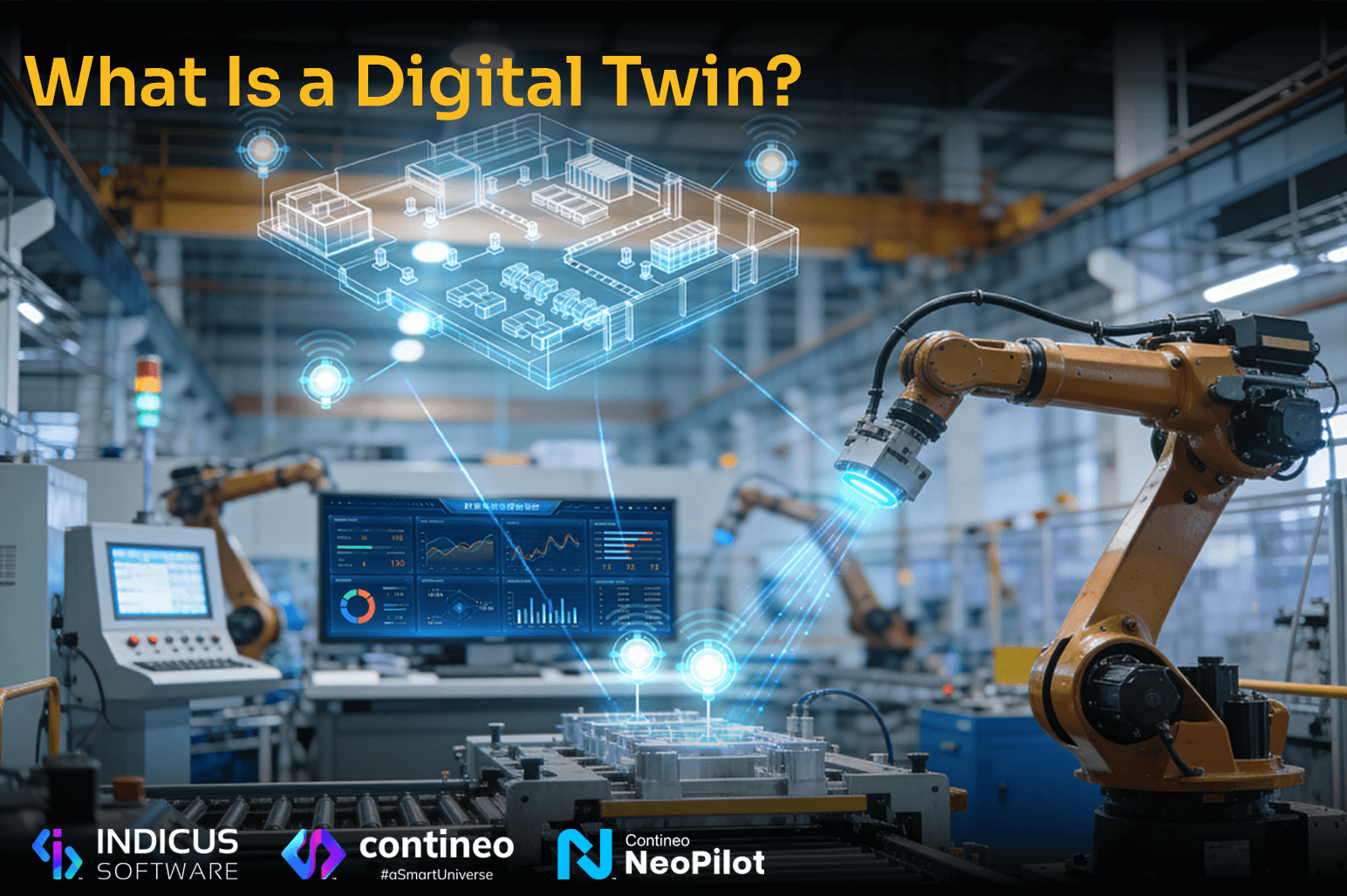
A digital twin is a virtual representation of a physical asset, process, or environment that mirrors real-world behavior through real-time data, analytics, and AI. Unlike traditional models or simulations, a digital twin is dynamic; it evolves every second as the real asset changes. This makes it one of the most powerful tools for modern decision-making. From monitoring a single machine to simulating the behavior of an entire factory, farm, or enterprise system, digital twins help organizations transition from reactive operations to predictive, intelligent, and optimized performance.
Understanding What a Digital Twin Really Is
At its core, a digital twin brings together physical systems and digital intelligence. IoT sensors continuously capture data such as vibration, temperature, pressure, speed, soil moisture, performance cycles, or quality parameters and stream it into a virtual model. This model uses AI, machine learning, and analytics to understand how the asset is performing, how it might behave in the near future, and what actions could optimize its performance.
What makes a digital twin powerful is not the visual representation itself, but the intelligence behind it. A true digital twin learns from historical patterns, interprets live conditions, and predicts outcomes, enabling leaders to see not only what is happening but also what is likely to happen next. It becomes a strategic advisor providing recommendations that improve uptime, enhance safety, ensure quality, reduce waste, and shorten innovation cycles.
Why Digital Twins Matter Now More Than Ever
Industries today operate in environments with far more uncertainty than a decade ago. Equipment is more interconnected, processes are more intricate, and operational risks are higher. In this new reality, traditional monitoring systems fail to provide the depth and responsiveness required. Digital twins step into this gap with real-time intelligence.
Executives use digital twins to make faster, more informed decisions, because they can visualize their operations exactly as they are supported by predictions and scenario simulations. Operations teams benefit from earlier warning signals when equipment deviates from ideal behavior. Quality teams can understand subtle variations long before defects appear. Supply chain leaders can simulate demand, material flows, and logistics disruptions. R&D and agronomy teams can test hypotheses digitally instead of waiting for long physical trial cycles.
In short, digital twins give every function a more reliable, data-backed way to operate.
This is why global studies from McKinsey and IBM highlight that companies adopting digital twins experience significantly lower downtime, more efficient processes, and faster innovation cycles.
How a Digital Twin Works: The Intelligence Behind the System
A digital twin operates through a continuous loop of sensing, simulating, predicting, and improving. Sensors capture real-time data from machines, fields, or processes. This data flows into a digital engine that mirrors how the real asset behaves under current conditions. AI and machine learning models analyze the patterns, identify anomalies, and forecast what may happen next. Finally, insights are sent back to stakeholders’ maintenance teams, operators, managers, or automated control systems to trigger actions that improve performance.
This closed-loop system transforms operations from reactive to predictive. It allows organizations to understand the full lifecycle of their assets, see early indicators of degradation, optimize performance parameters, and experiment with process changes safely in a digital environment before applying them in the physical world.
Where Digital Twins Are Making the Biggest Impact
Digital twins are no longer limited to high-tech industries; they are becoming mainstream across manufacturing, chemicals, agriculture, energy, automotive, and consumer goods. In manufacturing, for example, digital twins help organizations simulate production lines, analyze cycle times, evaluate quality deviations, and optimize throughput. Asset-intensive sectors use them to model equipment behavior and reduce downtime. Agriculture enterprises leverage digital twins to predict crop growth patterns and soil behavior. Quality-focused industries use them to trace product genealogy and forecast quality deviations long before they impact customers.
Across these scenarios, digital twins elevate operational maturity, enabling better planning, better control, and better outcomes.
Digital Twins and Asset Management: How Contineo Strengthens Enterprise Reliability
Asset-intensive operations benefit tremendously from digital twins because they finally gain visibility into how equipment behaves throughout its lifecycle. With Contineo, organizations can build digital twins that track asset performance in real time, compare live behavior against ideal conditions, and detect anomalies early. IoT-enabled asset monitoring provides continuous data flows, while Contineo’s maintenance systems automate work orders, schedule interventions, and ensure that field teams have the information needed to act quickly.
Performance analytics provide deeper insights into energy consumption, load variations, and performance drift. By creating digital counterparts for critical assets, Contineo helps leaders identify optimization opportunities that would otherwise remain hidden. This predictive approach extends asset life, reduces failures, and enables smarter repair-replace decisions.
Digital Twins and Quality Management: Achieving Predictable, Repeatable Excellence
Quality management is where digital twins offer some of the most transformative benefits. Instead of relying only on manual inspections or traditional CAPA processes, digital twins create a continuously updated “digital thread” that connects materials, suppliers, production parameters, test results, and final product outcomes.
Contineo integrates digital signatures, audit trails, and supplier quality tracking into this framework, enabling organizations to build multi-tiered quality models. AI-driven defect detection adds another layer of intelligence by identifying patterns invisible to the human eye.
With a digital twin of the quality process, teams can trace the complete genealogy of a product, understand the root cause of deviations faster, and implement improvements that are validated through simulation before being applied on the shop floor. This reduces scrap, improves compliance, and elevates customer satisfaction.
Digital Twins for R&D and Agronomy: Accelerating Innovation
Digital twins are revolutionizing how research and agronomy teams design, test, and refine new concepts. Instead of running long, expensive physical trials, they can simulate different conditions, test hypotheses, and evaluate performance digitally.
In agriculture, for example, digital twins can simulate crop growth by combining soil behavior, climatic conditions, and genetic models. This significantly accelerates breeding cycles and helps scientists make better decisions about nutrients, planting patterns, and crop protection strategies.
Contineo’s AI-driven agronomy workflows allow researchers to build digital farms, compare different scenarios, and deploy insights directly into operational systems through low-code applications. This makes innovation faster, more controlled, and far more cost-efficient.
Challenges Enterprises Face in Implementing Digital Twins
Despite their benefits, digital twins require thoughtful implementation. Many organizations struggle with fragmented data across ERP, MES, SCADA, and field systems. Older machines lack sensor capabilities. Teams may lack AI or process modeling expertise. Cybersecurity must be carefully planned.
This is where Contineo’s low-code approach becomes essential. By providing pre-built connectors, AI pipelines, and configurable twin templates, Contineo reduces complexity and enables organizations to adopt digital twins quickly even in environments dominated by legacy equipment.
How Digital Twins Drive Enterprise-Wide Value
Enterprises turn to digital twins because they deliver measurable outcomes. They reduce downtime, improve quality, shorten maintenance cycles, enhance planning accuracy, strengthen compliance, and accelerate R&D. When integrated across functions, operations, quality, maintenance, supply chain, and research, digital twins become the backbone of a modern digital enterprise.
With the ability to simulate, predict, and prescribe actions, digital twins help leaders operate with confidence and foresight. They transform how organizations maintain assets, ensure quality, allocate resources, and innovate for the future.
Digital Twin Technology Is Redefining the Future of Intelligent Operations
Digital twins are no longer experimental; they are becoming a strategic foundation for organizations looking to compete in increasingly complex markets. They provide the real-time intelligence required to optimize performance, reduce risks, and innovate faster. As industries move toward more autonomous, data-driven operations, digital twins will form the core of this transformation.
Platforms like Contineo and NeoPilot make digital twin adoption easier, faster, and more integrated, bridging physical assets with digital intelligence through low-code workflows, IoT integration, AI-driven simulation, and enterprise-grade analytics. Whether you are managing critical equipment, improving product quality, or driving agricultural research, digital twins offer the intelligence needed to lead with confidence.
See how digital twins can reduce downtime, improve quality, and accelerate innovation.